


Tucked into a side street of Seoul’s busiest shopping district sits a four-story noodle house that has quietly defined Korean comfort food for nearly six decades. Myeongdong Kyoja serves only four dishes — and that’s exactly why the line wraps around the building every lunch hour. Listed in the Michelin Guide year after year, this 1966 institution is where locals, office workers, and curious travelers crowd in for hand-cut noodles in a deeply smoky chicken broth, plump pork-filled mandu, and the most aggressively garlicky kimchi in the city. Here’s what makes it worth every minute of the wait.
Myeongdong Kyoja: Seoul's Michelin Kalguksu Since 1966
5
Myeongdong Kyoja: Seoul's Michelin Kalguksu Since 1966
5
Jung-gu, Seoul 29, Myeongdong 10-gil
Editor: James Lee


Interior08
Food07

Menu01
Overview
+82 02-776-5348
Free WiFi Available
Indoor Seating Only
Electronic Payment, Credit Card accepted: American Express, Master Card, Visa
Introduction
Operating hours
Mon, Tue, Wed, Thu, Fri, Sat, SunAM 10:30 - PM 9:00
Menu
Editor's Detail
Table of Contents
- The Story Behind Myeongdong Kyoja: A 60-Year Seoul Legend
- Why the Kalguksu Tastes Like Nothing You’ve Had Before
- The Mandu: Korea’s Answer to Xiao Long Bao
- The Infamous Garlic Kimchi (The Real Star of the Table)
- How to Order Like a Local: Menu, Prices, and Refills
- Korean Food FAQ: What First-Timers Should Know
- Practical Visitor Guide: Hours, Address, and Tips
- Where to Eat and Explore Nearby in Myeongdong
The Story Behind Myeongdong Kyoja: A 60-Year Seoul Legend
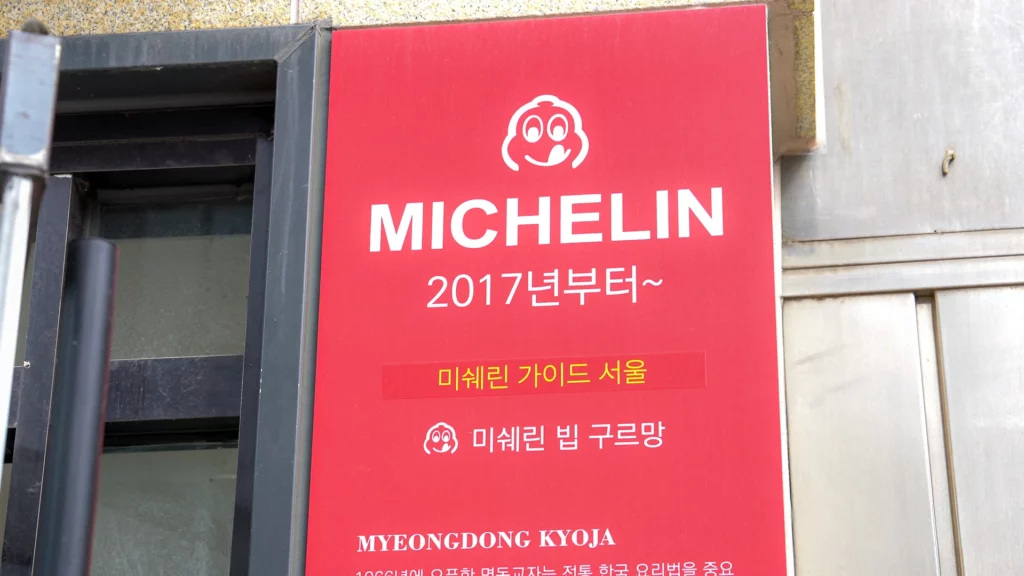
Myeongdong Kyoja’s story begins in 1966 in Suhadong, Jung-gu, in a renovated traditional hanok (Korean wooden house) where the original owners served kalguksu under the name Jangsujang. At a time when wheat noodles were being actively promoted by the Korean government to combat the country’s rice shortage, the family pioneered something genuinely new: a hand-cut wheat noodle in chicken-and-bone broth, finished with sautéed zucchini, pungent onion, and a scattering of seasoned ground meat. That formula is what people now call Myeongdong-style kalguksu, and Myeongdong Kyoja is credited as its origin point.

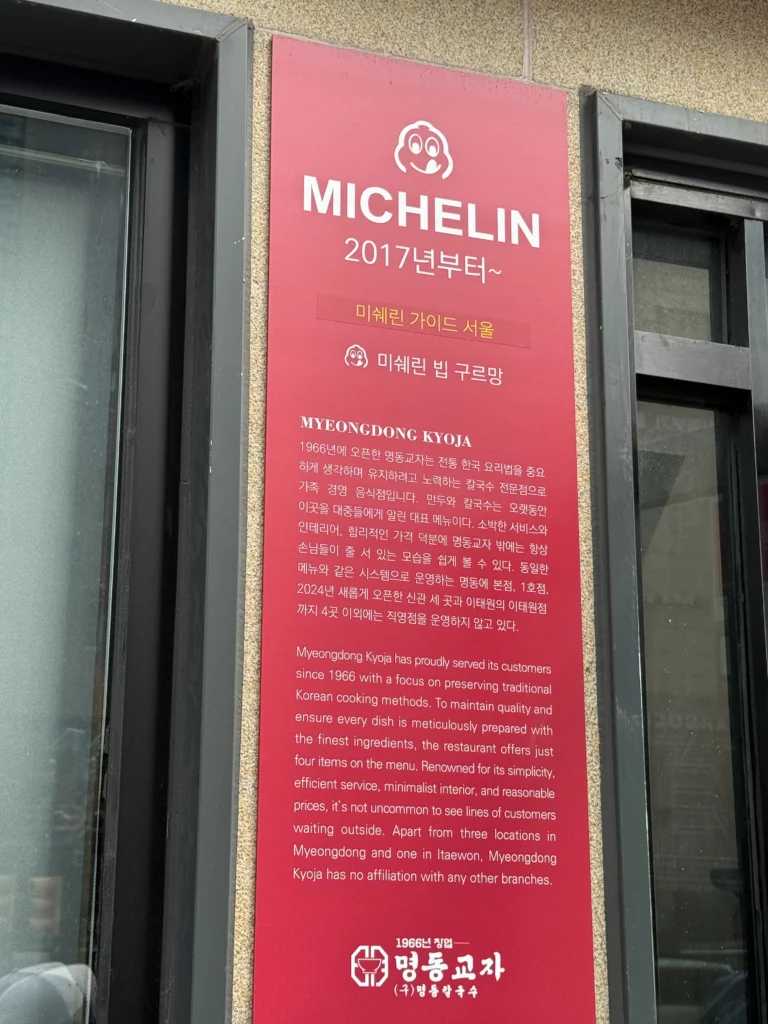
After moving the shop to what was then Seoul’s most glamorous district — Myeongdong itself — the restaurant briefly went by the name "Myeongdong Kalguksu." As copycats with similar names diluted the brand, the family renamed it Myeongdong Kyoja (명동교자) in 1978, using the Sino-Korean word for dumpling to anchor a name no one could imitate. The main branch has held its address at 29 Myeongdong 10-gil ever since, with two additional outlets and an annex just a few blocks away. The restaurant is also officially designated as a Seoul Future Heritage site by the Seoul Metropolitan Government, marking it as a cultural establishment worth preserving for future generations.

What makes the Michelin recognition notable is its consistency. Year after year, the restaurant returns to the Bib Gourmand list — a category that prizes quality, value, and craft over white tablecloths and twelve-course tasting menus. A complete lunch here, even with mandu added, lands comfortably under ₩30,000 for two people.
Why the Kalguksu Tastes Like Nothing You’ve Had Before
Most international visitors arrive expecting kalguksu to taste like a Korean version of Italian chicken noodle soup. It does not.
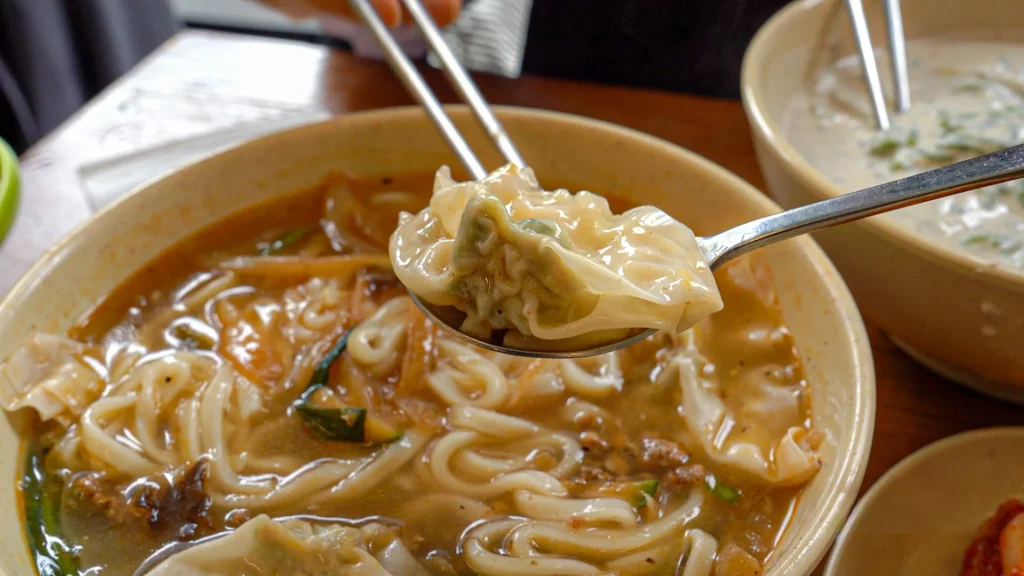
The broth at Myeongdong Kyoja carries a deep, smoky, almost roasted character that surprises people on the first sip. There’s no seafood here — no anchovy, no kelp, no clams. Instead, the kitchen builds the broth from chicken and pork bones, layered with deeply caramelized onions and a hit of bul-mat (불맛) — the singed, wok-fired flavor that Korean cooks chase with deliberate intent. The result is a soup that reads simultaneously light and richly savory, with a pale color that doesn’t betray its complexity. For a deeper understanding of how Korean broths build flavor without seafood, our companion guide to Dak Kalguksu, Korean chicken noodle soup, walks through the technique a home cook can replicate.
The noodles themselves are hand-cut from fresh dough every morning. Made from Korean medium-strength wheat flour, they sit somewhere between Italian fettuccine and Japanese udon in texture — tender, slippery, with just enough bite to hold the broth without turning mushy. If you’ve ever wondered why Korean wheat noodles read differently from Western pasta, our Korean flour ingredient guide breaks down the protein and processing differences that create that specific chew.
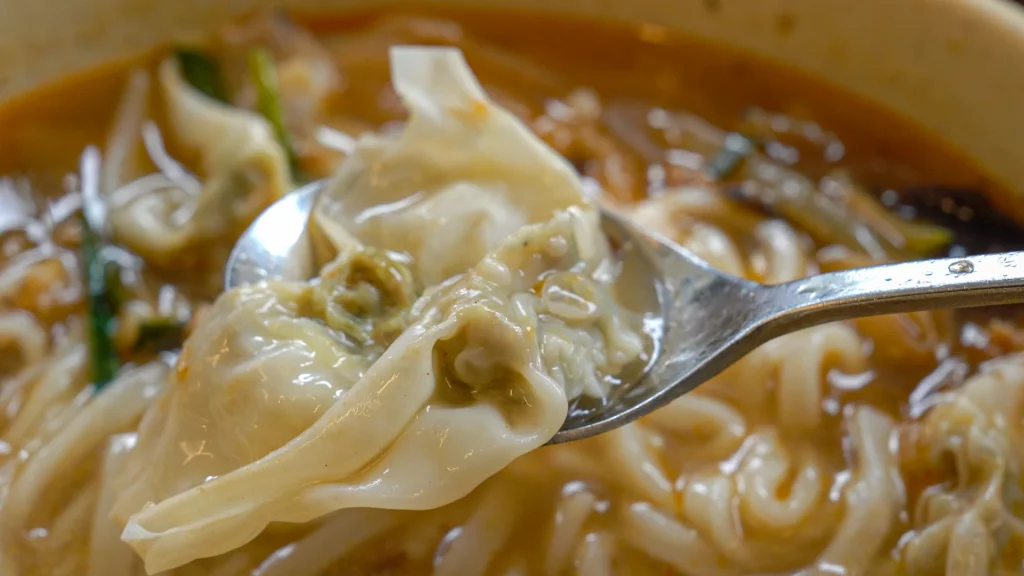
A typical bowl arrives topped with a scoop of seasoned minced beef, thin slices of zucchini, slivers of egg garnish, and two or three petite half-moon dumplings nestled into the noodles. The presentation is unfussy. The flavor is anything but.
The Mandu: Korea’s Answer to Xiao Long Bao
The restaurant’s name literally tells you what the kitchen takes seriously. Kyoja (교자) is the Sino-Korean reading of the same character used for gyoza — the dumpling. And the mandu here justify the signage.

Ordered as a separate dish, a plate of mandu arrives as ten plump half-moon parcels, their skins thin enough to be slightly translucent, their fillings dense with pork, garlic chives, zucchini, and a generous splash of toasted sesame oil. The first bite releases a surge of savory juices that recall Shanghai’s xiao long bao, but with a distinctly Korean balance — less oily, more aromatic, and shot through with the green sharpness of buchu (Asian chives). For a fuller look at how Korean dumplings differ from their Chinese and Japanese cousins, our complete guide to Korean mandu traces the dish back through the Silk Road and the Goryeo Dynasty.
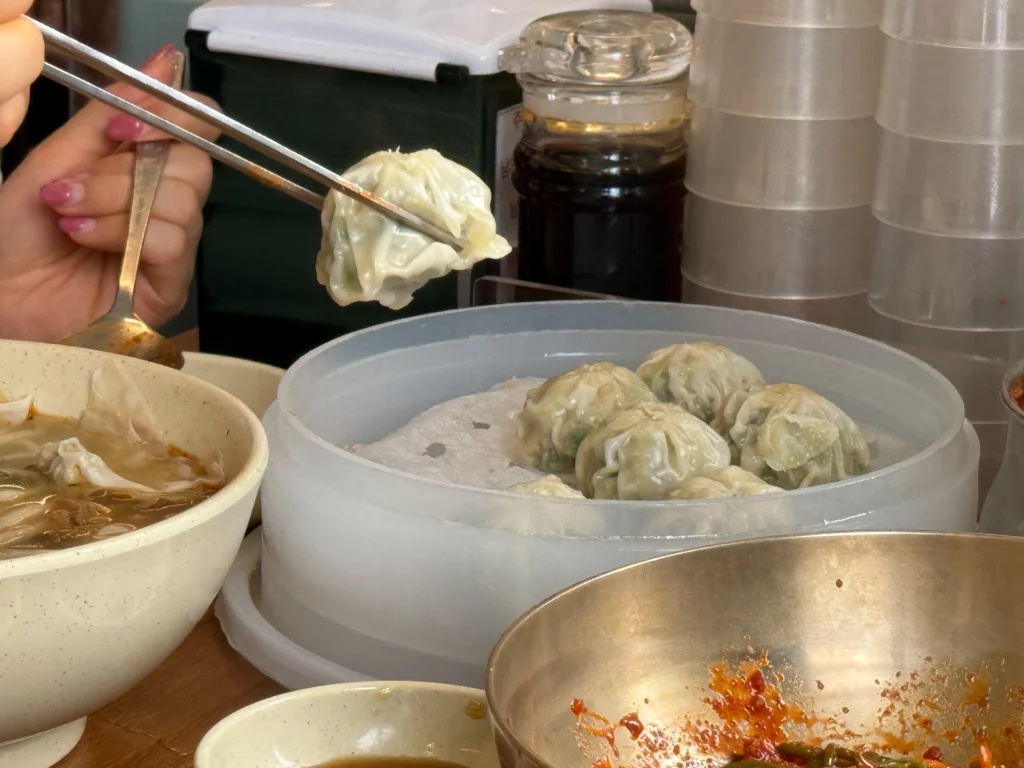
Many regulars order one kalguksu and one mandu plate to share. The dumplings can also be ordered for takeout — the only menu item permitted to leave the building — and a portable container of house-made garlic kimchi comes packed alongside them.
The Infamous Garlic Kimchi (The Real Star of the Table)
Ask any Korean who’s been here what they remember about Myeongdong Kyoja, and most won’t lead with the noodles. They’ll lead with the kimchi.
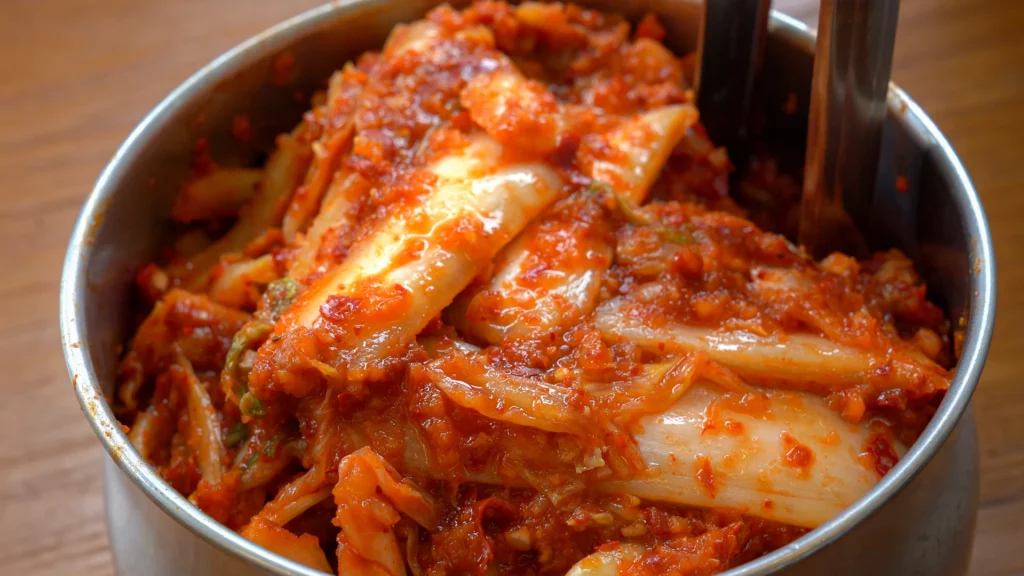
This is not the gently fermented, balanced baechu-kimchi you’ll find at most Seoul lunch counters. Myeongdong Kyoja’s house-made kimchi is built around an almost reckless quantity of raw, finely crushed garlic — so much that long-time customers describe their first taste as "stunning." The chili heat is moderate; the garlic intensity is the headline. Some diners eat one small bite per kalguksu spoonful and consider it perfect. Others go through three or four refill plates and leave the restaurant with a fragrance that no breath mint can fully erase. A few find it overwhelming. Almost no one forgets it.
This is, by design, kimchi engineered for kalguksu. The fat in the broth needs an aggressive counterweight, and the garlic, salt, and lactic tang of the kimchi clear the palate between every spoonful. For travelers curious about how kimchi achieves this kind of complex flavor through fermentation — and why garlic is so central to the Korean kimchi-making tradition — our deep dive into kimchi as Korea’s fermented superfood and our piece on the kimjang tradition and fermentation science provide essential background. Garlic itself is a foundational pillar of Korean cooking — its role in everything from kimchi to ssamjang is explored in our Korean garlic ingredient guide.
The pro tip: the kimchi is unlimited and self-serve, refilled at the side of the dining room. Take a small amount, eat it with noodles, return for more if you want. Don’t pile a mountain onto your starter plate.
How to Order Like a Local: Menu, Prices, and Refills
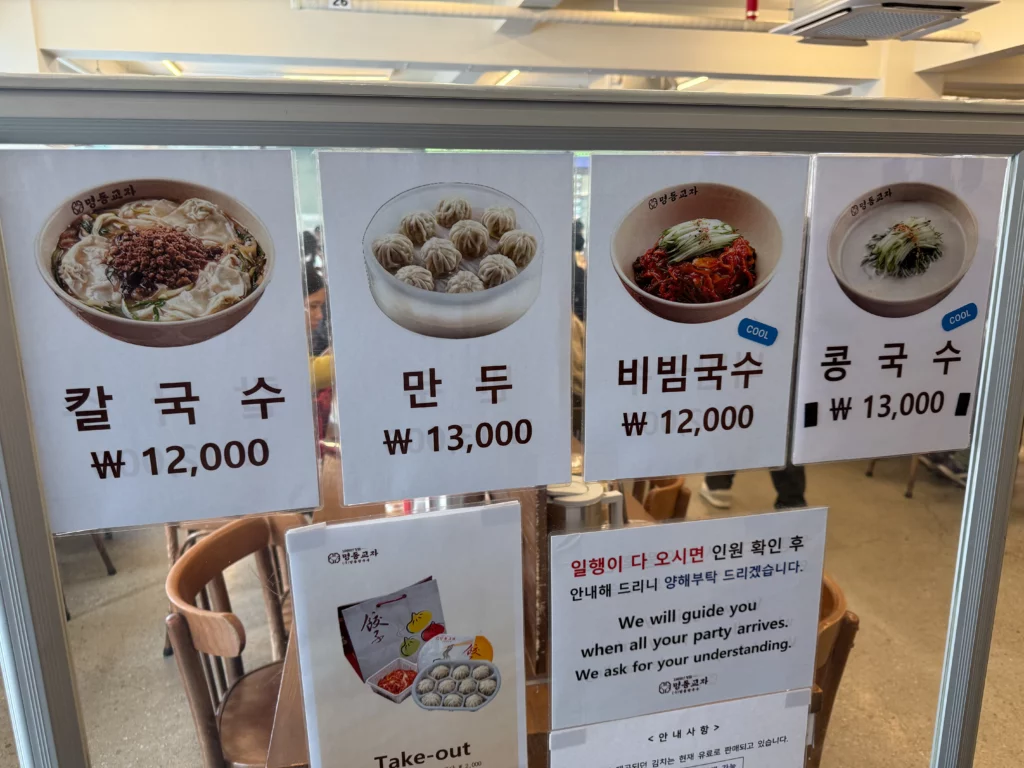
Myeongdong Kyoja keeps things radically simple. The full menu fits on a single wall poster:
- Kalguksu (칼국수) — chicken-and-bone broth knife noodles with mini dumplings: around ₩12,000
- Bibim-guksu (비빔국수) — chilled wheat noodles in a fiery red gochujang sauce with cucumber: around ₩12,000
- Mandu (만두) — ten steamed pork-and-chive half-moon dumplings: around ₩13,000
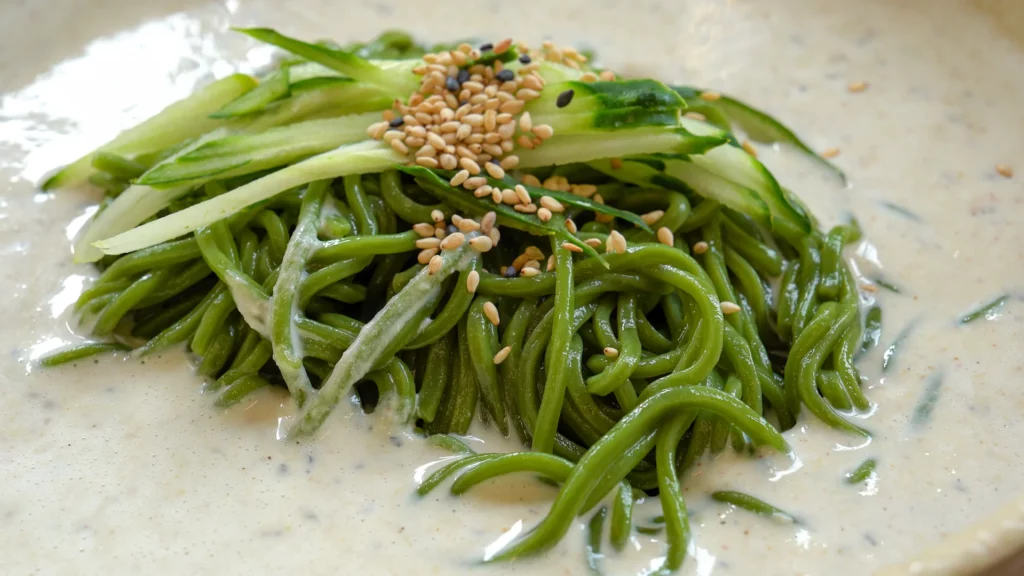
- Kongguksu (콩국수) — cold chlorella-tinted green noodles in chilled soybean soup; seasonal, April–October only: around ₩13,000

The critical insider tip — and this is the one most foreign visitors miss: when each person at your table orders at least one noodle dish, the restaurant provides a free additional portion of noodles (sari) and a bowl of rice. This is the secret to leaving genuinely full. The standard portion is modest by Seoul standards, but with a free sari refill added halfway through, the meal becomes substantial. (As of recent updates, rice refills are typically limited to one bowl, while noodle refills remain unlimited — confirm with staff on arrival.)
The ordering flow at the main branch is also worth understanding:
- Join the queue. Solo, two-person, and group lines are split.
- Decide your order while you wait — menu photos are mounted on the wall.
- Pay first at the counter before being seated (this is a pre-payment system).
- A staff member or robot server will deliver food to your table within minutes.
- Help yourself to the unlimited self-serve garlic kimchi station at the side.
- Ask staff (or use simple pointing) for a sari refill when your noodles run low.
Turnover is famously rapid. Even when the line looks long, expect to wait 15–25 minutes during peak hours.
Korean Food FAQ: What First-Timers Should Know
What makes Myeongdong Kyoja’s kalguksu uniquely Korean?

Kalguksu is one of Korea’s defining comfort foods — hand-cut wheat noodles in a long-simmered broth, eaten as a one-bowl meal rather than as a course in a larger banquet. According to the official Korea Tourism Organization profile of Myeongdong Kyoja, the restaurant is credited as the originator of the Myeongdong-style kalguksu built on rich chicken broth and accompanied by hand-folded dumplings. What separates it from regional rivals — the seafood kalguksu of the coast, the sagol (ox bone) kalguksu of Bukchon — is that pronounced smoky depth and the deliberately fiery, garlic-laden kimchi designed to cut through the broth’s richness.
What are the key ingredients that create this flavor?
Three components define the dish:
- Korean wheat flour (밀가루) — Medium-strength flour kneaded into a dense dough, hand-rolled, and sliced with a knife into irregular noodles that grip the broth.
- Chicken-and-pork bone broth (육수) — Long-simmered with caramelized onion and finished with a deliberate bul-mat (fire-roasted) note that creates the kalguksu’s signature smokiness.
- Raw crushed garlic (마늘) — The defining ingredient in the house kimchi, used in a quantity that genuinely surprises first-time eaters and creates a probiotic, pungent counterweight to the rich noodle soup.
How would you describe the taste and spice level?
The kalguksu itself sits at a gentle 2 out of 10 on the spice scale — clean, savory, warming. The mandu is mild and aromatic. The garlic kimchi, however, climbs to a 6 or 7 depending on how much you eat at once — not from chili heat but from raw garlic intensity and lactic tang. The overall flavor profile is savory, smoky, umami-forward, and lightly fermented, with a soft, slurpable texture for the noodles and a juicy interior for the dumplings. Everything arrives piping hot.
What should first-time eaters know?
Three practical things. First, pay before you sit — the pre-payment system is non-negotiable and trips up many travelers. Second, don’t fill up on kimchi alone; pace yourself so you can enjoy the sari (free noodle refill) that arrives halfway through. Third, eat the kimchi the way locals do — pick up a small piece with chopsticks, then immediately follow with a spoonful of noodles and broth. Eating the kimchi alone is overwhelming; eating it with the kalguksu is when the dish reveals why this restaurant has lasted 60 years. For broader context on how the small side dishes anchor every Korean meal, the complete guide to banchan explains the cultural philosophy at work.
Practical Visitor Guide: Hours, Address, and Tips
Address: 29 Myeongdong 10-gil, Jung-gu, Seoul (서울특별시 중구 명동10길 29) Subway: Myeongdong Station (Line 4), Exit 8 — about a 3-minute walk Phone: +82-2-776-5348 Hours: Daily, 10:30 AM – 9:00 PM (last order 8:30 PM); closed on Seollal (Lunar New Year) and Chuseok Price Range: ₩11,000 – ₩14,000 per person Payment: Pre-payment required at counter; cash and credit cards accepted Reservations: Not accepted — walk-in only
Best time to visit:
- Before 11:30 AM — first half-hour after opening; minimal wait
- 3:00 PM – 4:30 PM — true off-peak; often walk-straight-in
- Avoid: 12:00 – 1:30 PM on weekdays and any weekend lunch hour
Other tips that help:
- The restaurant occupies a multi-story building — staff direct you upstairs once you’ve paid.
- Communal table seating is normal during peak hours; solo diners are often seated within five minutes.
- Robot servers handle some food delivery and bussing; this is part of the operational efficiency, not a gimmick.
- Mandu is the only item available for takeout (with kimchi included).
- The dining room is tight; large luggage is difficult to accommodate.
Where to Eat and Explore Nearby in Myeongdong
Myeongdong is one of Seoul’s densest food and shopping clusters, and a kalguksu lunch pairs beautifully with a half-day of exploration. The most rewarding walking radius covers a few blocks in any direction from Myeongdong Station.
Just minutes away stands Myeongdong Cathedral, Korea’s first Gothic-style building and a quiet historic counterweight to the neighborhood’s neon. Our Myeongdong Cathedral cultural guide covers its consecration in 1898 and surprising role in Korea’s democracy movement. For an after-lunch coffee with the cathedral and Namsan Tower framed in the same view, Cafe Pines Myeongdong on the third floor of Page Myeongdong is the rooftop pick.
If you want to taste a different historic Seoul kalguksu for comparison, Hwangsaengga Kalguksu in Bukchon offers a creamy sagol (ox bone) broth that contrasts beautifully with Myeongdong Kyoja’s smoky chicken style — both are Michelin Bib Gourmand restaurants serving the same dish category with very different philosophies. For travelers who fell in love with the mandu and want to dive deeper into Korean dumpling tradition, Bukchon Son Mandu — a 70-year handmade dumpling institution — sits a short subway ride away. Another worthy Michelin Bib Gourmand stop nearby is Mijin in Pimatgol, a Seoul Future Heritage site celebrated for buckwheat noodles. And if you want a completely different historic Myeongdong experience the next day, Gaehwa has been serving Korean-Chinese jajangmyeon for six decades just minutes away.
Home cooks inspired to recreate the experience can start with our Mandu-guk dumpling soup recipe — a near-instant approximation of the kalguksu-with-mandu pairing using store-bought Korean dumplings.
Go, and Don’t Be Discouraged by the Line

Myeongdong is one of the most photographed neighborhoods in Korea, and most restaurants here cater hard to short-stay tourists. Myeongdong Kyoja is the exception. The dining room is still packed with Korean office workers, elderly regulars who have been coming since the 1970s, and families who bring kids the way American families bring kids to a neighborhood diner. The food is the same food the Park family has been making for nearly 60 years. The kimchi is still scandalously garlicky. The free noodle refill is still the city’s best-kept lunch deal.

If you find yourself standing in front of a line that stretches into the street, stay. Turnover is fast. The wait is rarely more than 25 minutes even at peak. And the bowl that arrives at your table — that smoky, savory, pale-gold broth crowded with hand-cut noodles and a half-moon dumpling or two — is a piece of Korean food history you can’t easily find anywhere else.
For a taste of Seoul that explains why kalguksu became a national comfort food in the first place, plan your visit to Myeongdong Kyoja Main Branch. Arrive hungry, pay at the counter, eat the kimchi with the noodles, ask for the sari refill, and leave full. Share this guide with anyone heading to Seoul who’s tired of generic shopping-district food and ready for the real thing.
Location
29, Myeongdong 10-gil, Jung-gu, Seoul, KR
Reviews
5.0
0 reviews
5
0%
4
0%
3
0%
2
0%
1
0%
Loading reviews...
Related Recipes

Soups
Mandu-guk: Korean Dumpling Soup
There are evenings when you need dinner on the table in under 20 minutes — and you also need it...

Meat & Poultry
Korean Pork Dumplings (Gogi Mandu)
Learn to make authentic Korean pork dumplings (gogi mandu) at home with this complete guide. Master traditional techniques, essential ingredients,...


Beef
Somunnan Seongsu Gamjatang: Seongsu's 24-Hour Pork Stew
Seongdong-gu, Seoul 45, Yeonmujang-gil,
5

Beef
Saejae Halmaejip: Mungyeong's Yakdol Pork Since 1973
Mungyeong-si, Gyeongsangbuk-do 922, Saejae-ro, Mungyeong-eup
4

Beef
Ilsang Jeongwon: Shabu Shabu at Seoul Express Bus Terminal
Seoul FP103, 205, Sapyeong-daero, Seocho-gu, Seoul
5

Beef
Seoul Prime: Falls Church's Korean Steakhouse Redefining Premium Beef
106 Founders Ave, Falls Church, VA 22046
5