


🩺 The Honest Take
The difference is simpler than the labels make it sound: a probiotic is the live bacteria, and a prebiotic is the fiber that feeds them. On the Korean plate, kimchi and doenjang sit on the probiotic side, while kongbiji (soy pulp) and barley sit on the prebiotic side — and eating both is what scientists now call a synbiotic. My caveat: the definitions are settled, but a food carrying live bacteria or fiber is not the same as a proven clinical fix. Much of the Korean-food evidence, like kongbiji’s, is still lab-stage, and the gut-skin link is plausible but not proven.
A probiotic is live beneficial bacteria; a prebiotic is the dietary fiber that feeds them. In Korean cooking, kimchi (김치) and doenjang (된장) supply probiotics, while kongbiji (콩비지 — soy pulp) and barley supply prebiotic fiber. Eating both together forms a “synbiotic” — though most benefits are still being studied rather than proven.
The question behind prebiotic vs probiotic comes up constantly in my clinic, usually tangled together as if the two words meant the same thing. They do not. One is a living microbe; the other is the food that microbe eats — and once you see that split, sorting the Korean pantry becomes surprisingly intuitive.
Table of Contents
- What’s the Difference Between a Prebiotic and a Probiotic?
- Prebiotic vs Probiotic at a Glance
- Which Korean Foods Are Prebiotic, and Which Are Probiotic?
- Do You Need Both? The “Synbiotic” Korean Plate
- Why Should Your Skin Care? The Gut-Skin Axis
- What the Evidence Doesn’t Show
- Frequently Asked Questions
Evidence at a Glance
| Evidence Strength | Strong for the distinction itself, hedged for specific foods — the category definitions are settled science, but individual food claims (like kongbiji’s) rest on in-vitro work, not human trials. |
| Mechanism | A prebiotic is fiber your gut bacteria ferment into short-chain fatty acids that help support the gut lining; a probiotic is the live bacteria themselves, added to the mix. |
| Key Caveat | A food containing live microbes or fiber is not the same as a proven clinical benefit; effects are strain- and substrate-specific. |
| Best Form to Consume | Traditionally fermented, unpasteurized ferments for probiotics; whole high-fiber foods for prebiotics — ideally both in the same meal. |
| Audience Note | People who are immunocompromised, pregnant, or sensitive to FODMAPs should speak with their care team before adding live-culture or high-fiber foods. |
What’s the Difference Between a Prebiotic and a Probiotic?
Here is the whole distinction in one line: a probiotic is the live bacteria, and a prebiotic is the food those bacteria eat. Everything else is detail.
The definitions come from expert consensus panels. A probiotic is defined as “live microorganisms which, when administered in adequate amounts, confer a health benefit on the host,” per the ISAPP consensus statement on probiotics. A prebiotic is “a substrate that is selectively utilized by host microorganisms conferring a health benefit,” per the ISAPP consensus statement on prebiotics — note the word substrate. It is not the microbe; it is the raw material.

Mechanistically the two work through different doors. A prebiotic passes undigested to your colon, where resident bacteria ferment it into short-chain fatty acids — especially butyrate — that nourish the cells lining your gut. A probiotic instead adds live organisms that can transiently settle in, compete with less-friendly microbes, and interact with your immune system. One feeds the garden; the other plants it. Importantly, these are definitions of categories — they establish what a prebiotic or probiotic is, not that any particular food delivers a measured benefit.
Prebiotic vs Probiotic at a Glance
A side-by-side table settles the confusion faster than any paragraph. Here is the prebiotic vs probiotic contrast, with the Korean examples I reach for.
| Prebiotic | Probiotic | |
|---|---|---|
| What it is | A food substrate (mostly dietary fiber) selectively used by your gut microbes | Live microorganisms that, in adequate amounts, confer a health benefit |
| Simple analogy | The food for your good gut bacteria | The live bacteria themselves |
| How it works | Fermented in the colon into short-chain fatty acids (especially butyrate) that support the gut lining | Settle in the gut, compete with pathogens, and interact with immunity |
| Korean example | Kongbiji (콩비지 — soy pulp), barley (bori 보리), namul (나물) vegetable fiber | Kimchi (김치), doenjang (된장), cheonggukjang (청국장) |
| Western equivalent | Inulin, oats, garlic, bananas, onions | Yogurt, kefir, sauerkraut, live-culture capsules |
| What the evidence shows | Okara ferments to short-chain fatty acids and promotes bifidobacteria in vitro — human trials still needed | Commercial kimchi has been measured at ~10⁷–10⁹ CFU/g of live lactic-acid bacteria (Kim 2016); counts vary and benefits are strain-specific |

That mechanism spine — prebiotics fermented to short-chain fatty acids, probiotics competing with pathogens and modulating immunity, the two combined as a synbiotic — follows a 2025 review by Smolinska and colleagues in the Journal of Clinical Medicine mapping all four “biotics.” I lean on it for the framework while remembering the authors’ own caution that much of the mechanistic detail comes from in-vitro and animal work.
Which Korean Foods Are Prebiotic, and Which Are Probiotic?
Korean cooking earns its place here because the traditional table stocks both sides.
On the probiotic side are the ferments. Traditionally made kimchi is a living culture: commercial Korean kimchi has been measured at roughly 10⁷–10⁹ colony-forming units of lactic acid bacteria per gram (Kim et al., 2016), though the exact count varies with recipe, ripeness, storage temperature, and whether the product was pasteurized. For the material profile, see napa cabbage kimchi, Korea’s best-known probiotic ferment, and for how the bacterial mix shifts with time, how long-aged kimchi (mukeunji, 묵은지) changes its bacterial profile. Soybean ferments belong here too: doenjang, a live-fermented soybean paste on the probiotic side, which begins as meju (메주), the fermented soybean brick that seeds doenjang’s bacteria, plus fast-fermented cheonggukjang (청국장). Koreans did not invent these to deliver microbes — they were preserving food for winter — but the daily habit became a live-culture delivery system.

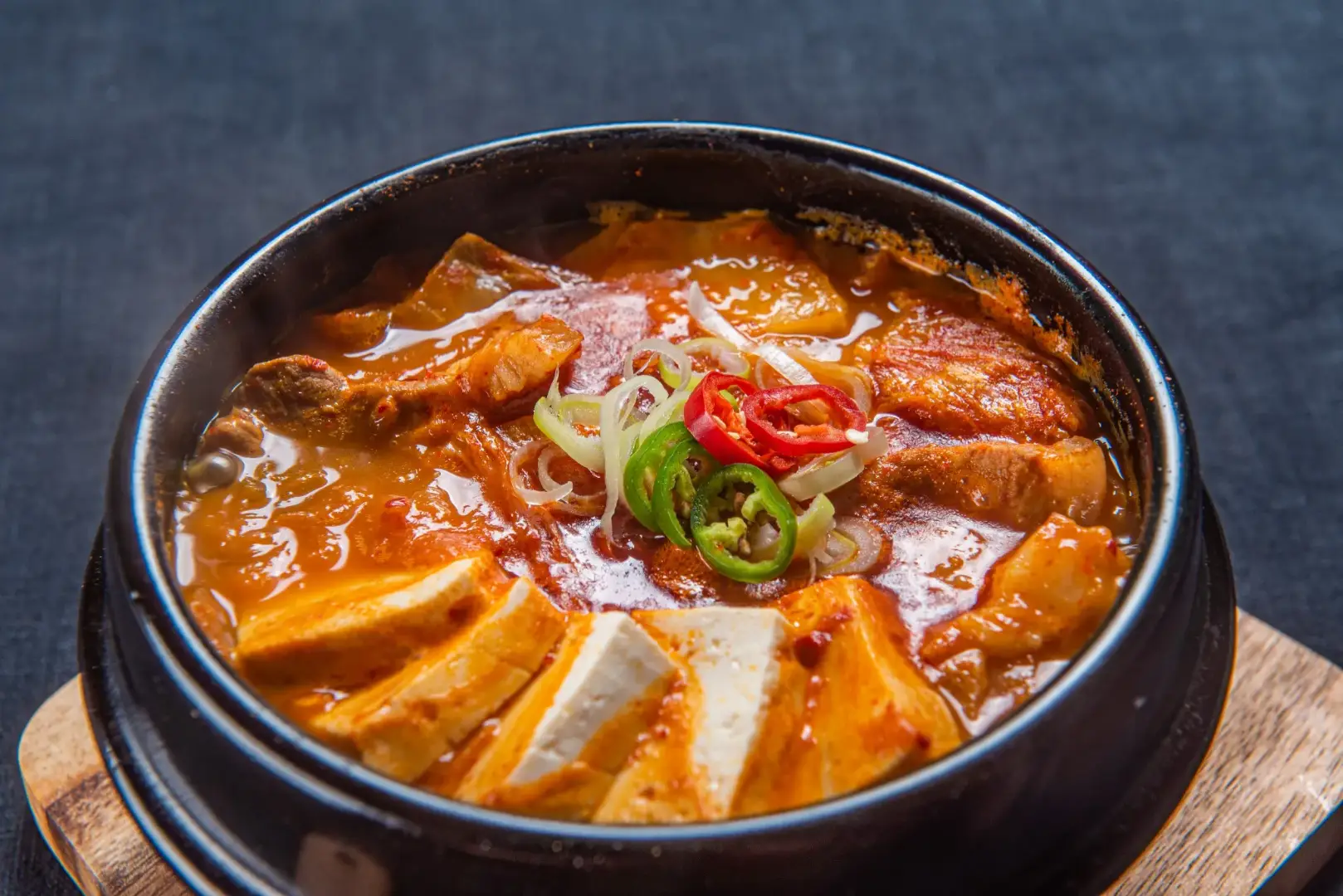
On the prebiotic side is the fiber. The clearest example is kongbiji (콩비지) — the soy pulp left over after making tofu, whose leftover soy pulp becomes kongbiji. Koreans have long simmered this byproduct into kongbiji-jjigae, a frugal use of something most kitchens discard. Modern work explains why it matters: an in-vitro study using human fecal microbiota found that okara — the same soy pulp — is fermented into short-chain fatty acids and promotes bifidobacteria and lactobacilli while suppressing less-desirable groups. That is textbook prebiotic behavior, though it was shown in a laboratory batch culture, not in people. Grains carry fiber too — see barley (bori, 보리), a prebiotic-fiber grain that feeds gut bacteria — as do the seasoned vegetable namul (나물) sides. If you want to build the probiotic side at home, here is how to make your own unpasteurized, probiotic-rich kimchi.

Do You Need Both? The “Synbiotic” Korean Plate
You do not need a supplement aisle to get both. When a prebiotic and a probiotic are eaten together — the fiber feeding the live bacteria so they survive and settle in — the pairing is called a synbiotic, and a balanced diet supplies it naturally.

A single Korean meal often assembles one by accident: kimchi or doenjang for the live cultures, kongbiji or boribap (보리밥 — barley rice) for the fermentable fiber, and namul vegetables for more. A mixed rice bowl is the tidiest illustration — a fiber-and-ferment bowl that pairs both biotic types — and you can build a prebiotic-rich vegetable bowl at home topped with a spoonful of kimchi to cover both sides at once.
Dr.’s Nutritional Insight
Beauty Benefit: Gut Health 🦠
What strikes me most is how sensible the synbiotic idea is once you strip away the marketing. Live bacteria have a better chance of doing something useful when the fiber that sustains them arrives in the same meal — which is exactly what the ISAPP prebiotic consensus (Gibson and colleagues, 2017) implies in defining a prebiotic as a substrate selectively used by host microbes. The Korean table has done this by habit for generations: a bite of kimchi alongside kongbiji or barley is a synbiotic assembled without the vocabulary. I frame it for patients as plausible support for gut balance, not a fix for anything — and if you are curious whether kimchi truly counts as a probiotic, that companion piece walks through the live-culture evidence in depth. — James Lee
Why Should Your Skin Care? The Gut-Skin Axis
Here is why a gut article lives in a beauty-and-health column: the gut and the skin appear to talk to each other. I want to be careful, because the enthusiasm online runs well ahead of the evidence.

The proposed route is the gut-skin axis. When gut microbes ferment fiber into short-chain fatty acids, those metabolites help support the intestinal barrier and lower gut permeability; some gut-derived signals then enter circulation and may influence inflammation and immune tolerance elsewhere, including the skin. A 2021 review in Microorganisms on the gut-skin axis and microbial dysbiosis lays out this interrelationship. But note the same authors’ hedge: the exact mechanisms are, in their words, currently being investigated, and the evidence that systemic short-chain fatty acids actually reach and act on skin is limited. So the honest framing is plausible and emerging, never proven — the thread that connects gut health to how the wider Korean diet supports gut and skin.
What the Evidence Doesn’t Show
A trustworthy guide has to say where the ground gets soft. First, the ISAPP papers are definitions, not proof that any specific food does something clinical — they tell you what a prebiotic or probiotic is, not that kimchi or kongbiji changes an outcome you can measure. Second, kongbiji’s prebiotic status rests on an in-vitro study; a batch culture simulates the gut, it does not replicate a living human one, so I say kongbiji behaves like a prebiotic, not that it is a proven one. Third, probiotic evidence is strain- and substrate-specific — meta-analyses across strains and indications are, candidly, not yet convincing enough for blanket promises, and “all fermented food fixes your gut” is exactly the overreach I talk patients out of. The distinction between the categories is strong; the leap from category to clinical benefit for a given food is where the honesty has to live.
Frequently Asked Questions
Is kongbiji really a prebiotic?
An in-vitro study using human fecal microbiota showed that okara — the soy pulp Koreans call kongbiji (콩비지) — is fermented into short-chain fatty acids and promotes bifidobacteria and lactobacilli, which is how a prebiotic behaves. But that is laboratory evidence, not a human trial, so the accurate statement is that kongbiji behaves like a prebiotic rather than being a proven one.
Is kimchi a prebiotic or a probiotic?
Kimchi is a probiotic food. Traditionally fermented, unpasteurized kimchi (김치) has been measured at roughly 10⁷–10⁹ live lactic-acid bacteria per gram in commercial samples (Kim et al., 2016), varying with recipe, ripeness, and storage. It is not a prebiotic, although its vegetables add some fiber. The common mix-up is assuming “fermented” and “fiber” mean the same thing — fermented means live microbes, fiber means their food.

Are there people who should avoid probiotics or high-fiber prebiotic foods?
Yes. People who are immunocompromised should speak with a physician before adding live-culture foods, and those with IBS or FODMAP sensitivity may react to a sudden jump in fermented or high-fiber intake. Fermented staples like kimchi and doenjang are also salty. The sensible approach is to increase them gradually and get personal guidance.
Do I need to take prebiotics and probiotics together?
You do not need supplements — a balanced diet can supply both. A single Korean meal that pairs kimchi (probiotic) with kongbiji or barley rice and namul vegetables (prebiotic fiber) naturally combines them, which is the synbiotic idea. Amounts used in studies are research measures, not personal prescriptions; enjoy both as ordinary food.
What is a postbiotic, and how is it different?

A postbiotic is a non-viable microbial component or metabolite — not the live bacteria, and not their food — that may still benefit the host. It rounds out the four “biotics”: prebiotic (the substrate), probiotic (the live microbe), synbiotic (both together), and postbiotic (the useful leftovers). It is best understood as an emerging category still being characterized.
⚕️ Medical Disclaimer
This article is for educational purposes only and is not a substitute for personalized medical advice. The information presented reflects current research at the time of publication and may evolve. Consult your physician before making significant changes to your diet, especially if you have a medical condition, are pregnant, are immunocompromised, are taking medications that may interact with foods or supplements, or are recovering from surgery. Always follow your own care team’s specific instructions.
Put Both on the Plate
Strip away the jargon and prebiotic vs probiotic is a simple pairing: probiotics are the live bacteria, prebiotics are the fiber that feeds them, and the Korean table has quietly served both for centuries. At your next meal, put the two side by side — a spoonful of traditionally fermented kimchi (김치) for live cultures alongside a fiber-rich prebiotic like kongbiji (콩비지) jjigae, boribap (barley rice), or a namul-packed bibimbap. That pairing is a synbiotic your gut can actually use, no supplement required.

If you want to go deeper on the probiotic-side foods, the companion pieces on whether kimchi truly counts as a probiotic and doenjang’s gut-health evidence in depth pick up the thread — all part of the Gut Health 🦠 focus of K-Beauty Kitchen.


