


Few meals carry more meaning than the one you eat just before boarding — or just after landing. At Incheon International Airport, Jayeon NATURE (자연), the premium Korean restaurant operated by iconic Walkerhill Hotels & Resorts, transforms that in-between moment into a genuine culinary experience. Whether you’re warming up with a crimson-red bowl of spicy beef soup or savoring the gentle earthiness of abalone porridge with pine mushroom, Jayeon delivers traditional Korean banga (aristocratic household) cuisine with a modern sensibility that makes it one of the most compelling Incheon Airport Korean restaurants for any traveler.
Jayeon NATURE: Best Incheon Airport Korean Restaurant
5
Jayeon NATURE: Best Incheon Airport Korean Restaurant
5
272 Gonghang-ro, Jung-gu, Incheon Terminal 1, 4F
Editor: Katie Lee


Interior01
Food01

Menu01
Overview
+82 032-743-5067
WiFi Provided
Outdoor Seating Available
Electronic Payment, Credit Card accepted: American Express, Master Card, Visa
Introduction
Operating hours
Mon, Tue, Wed, Thu, Fri, Sat, SunAM 6:00 - PM 10:00
Menu
Editor's Detail
Step through the doors of Jayeon NATURE on the 4th floor of Incheon International Airport’s Terminal 1, and the atmosphere shifts immediately. The scent of slowly simmered beef broth drifts from the kitchen. Wide glass windows frame a view of the tarmac, where aircraft glide in and out on runways bathed in afternoon light. A welcoming spread of banchan (반찬) — small side dishes — already waits at the table. This is the rare airport restaurant that earns its place as a destination in its own right.
Operated by the storied Walkerhill Hotels & Resorts, Jayeon is Korea’s hotel-grade restaurant inside Incheon Airport. It occupies a unique cultural position: this is not everyday fast food, nor a casual pit stop. Rather, it draws on the tradition of banga (반가) cuisine — the refined home cooking of Korea’s aristocratic Joseon-era families — reinterpreted with a modern dining sensibility to suit the rhythms of international travel. Think of it as similar to a refined French brasserie in a great European airport terminal, but rooted in centuries of Korean culinary heritage rather than Western bistro culture.
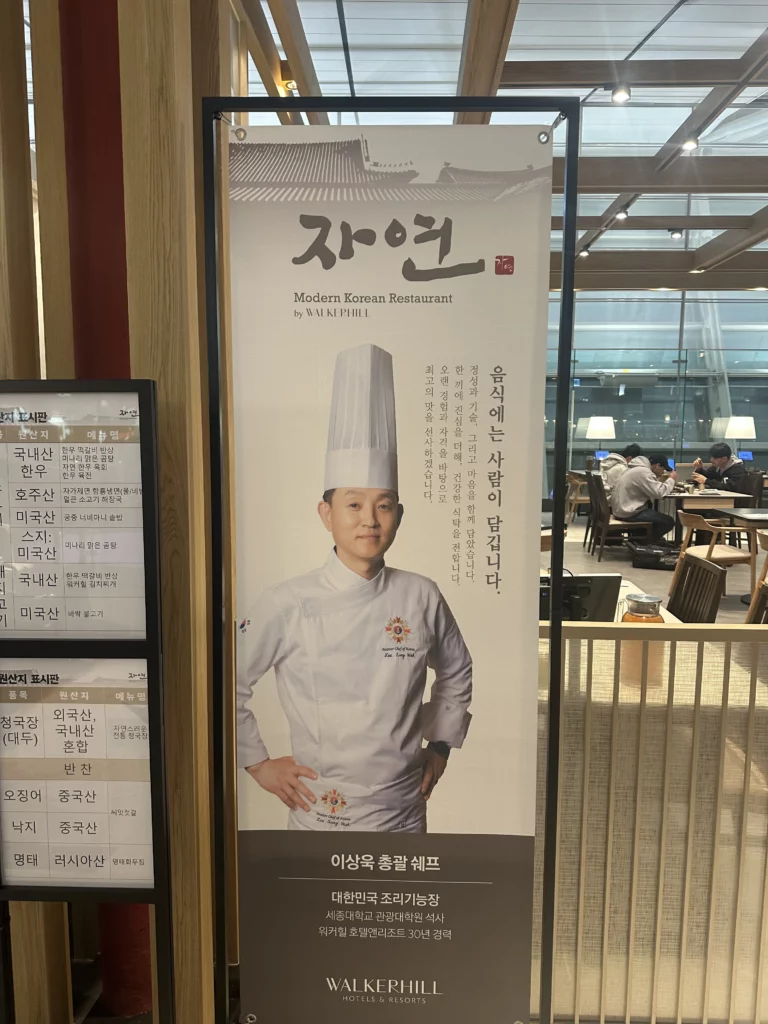
Table of Contents
- A Legacy Reborn at Korea’s Gateway
- What Makes Jayeon the Premier Incheon Airport Korean Restaurant?
- The Menu: A Journey Through Modern Korean Cuisine
- Key Ingredients That Define the Flavors
- FAQ: Everything You Need to Know Before You Visit
- Practical Visitor Information
A Legacy Reborn at Korea’s Gateway
The name Jayeon (자연) is not arbitrary. It derives from 자연도 (Jayeon-do, 紫燕島) — the old name for Yeongjongjdo Island, where Incheon Airport stands today. The name means "Purple Swallow Island," reflecting the birds that once filled the skies here. When Incheon Airport opened in 2001, Walkerhill launched Jayeon as its flagship Korean restaurant in the terminal. For fourteen years it served travelers at the gateway to Korea, before closing in 2015.
In November 2024, Walkerhill reopened Jayeon at Terminal 2, and on June 20, 2025, launched a second location at Terminal 1 — cementing its position across both terminals as Korea’s definitive airport Korean restaurant. The return is notable: Walkerhill, the brand behind renowned Seoul dining institutions such as Myeongwolgwan and Ondal, brings decades of fine Korean hospitality expertise to one of the world’s busiest international airports.
What Makes Jayeon the Premier Incheon Airport Korean Restaurant?
Jayeon reinterprets traditional banga cuisine through a modern dining style, with menus carefully designed to suit travelers’ journey purposes and schedules. This thoughtful, traveler-first philosophy distinguishes it from every other food option in the terminal.
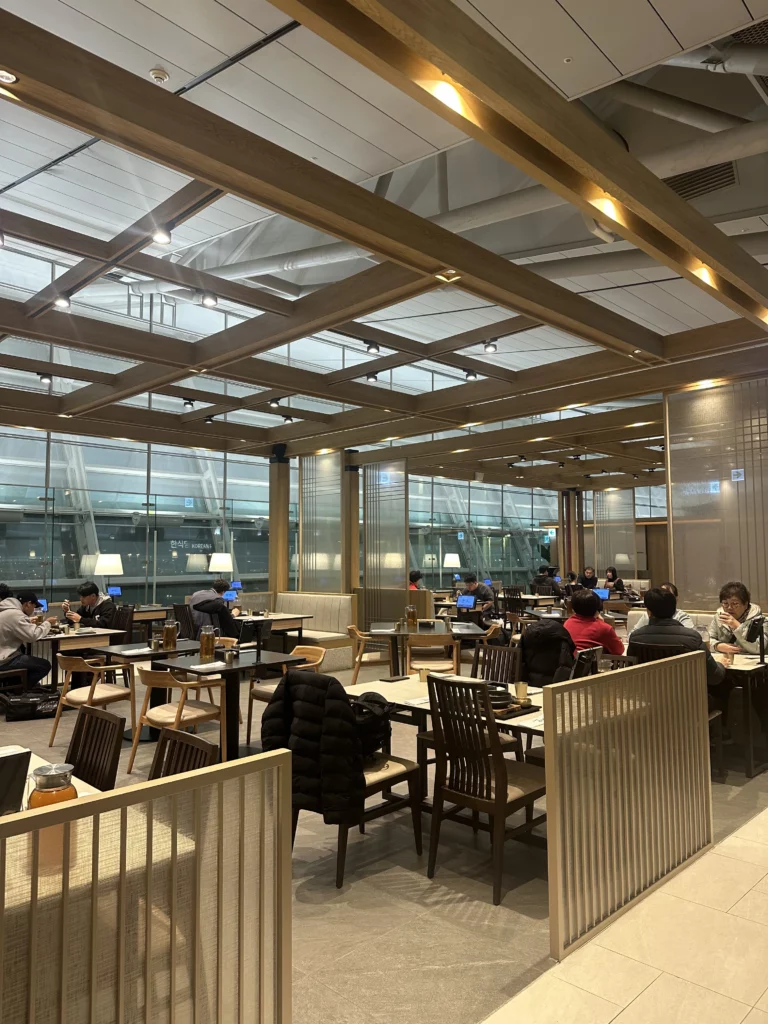
The Terminal 1 location seats 150 guests across a spacious hall of 130 seats and three private dining rooms (PDRs), each accommodating between 6 and 20 guests — ideal for family departures, business farewell meals, or group arrivals. A convenient table-ordering system means you can place your entire meal without waiting for a server, reducing stress during tight layovers.

The interior combines Korean classical aesthetics with sleek, contemporary design. Panoramic windows overlook the airport’s concourse and runways — a bonus during daytime visits when the view of incoming and outbound aircraft adds an unexpectedly theatrical backdrop to your meal. The generous table spacing creates a sense of ease that is rare in airport dining, and the light-filled, polished interior strikes visitors as notably calm for a busy terminal restaurant.
The Menu: A Journey Through Modern Korean Cuisine
Jayeon’s menu is built around the principle that every Korean dish, however humble its origins, deserves to be made with intention. Signature dishes on the Incheon Airport Korean restaurant menu reflect both traditional Korean soul food and globally appealing flavors.
Spicy Korean-Style Beef Soup — 얼큰 소고기 해장국
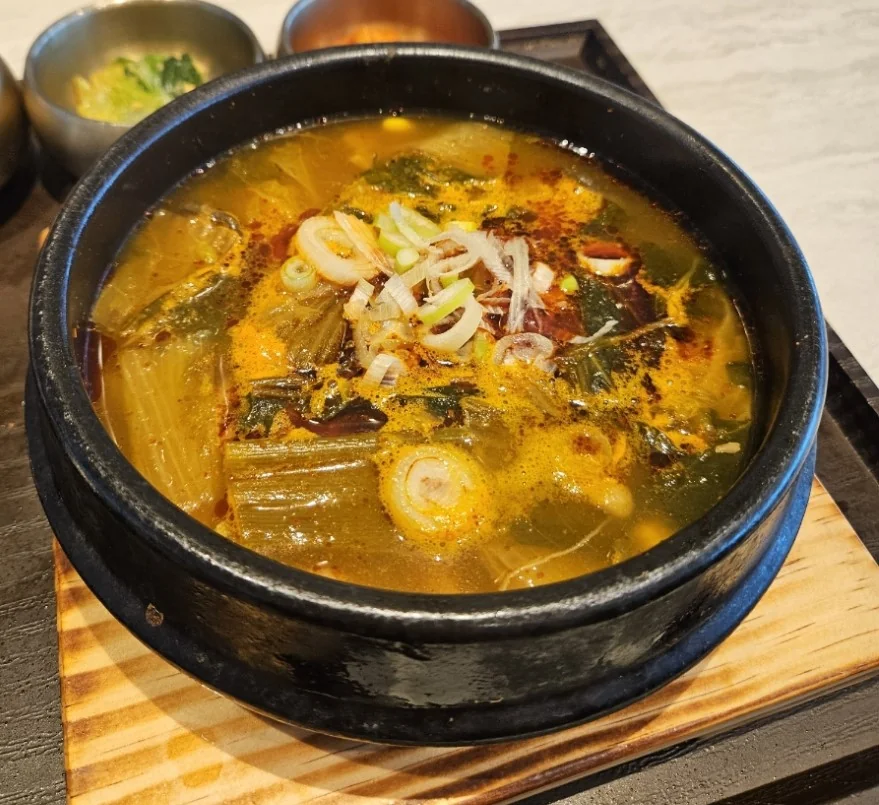
The menu’s most evocative dish is the Eolkeun Sogogi Haejangguk (얼큰 소고기 해장국), a deep-red, richly layered spicy beef soup that represents the Korean tradition of haejang-guk — the restorative "hangover soup" — elevated to refined restaurant standards. Rich, deeply savory beef broth is intensified with gochugaru (고추가루, Korean red chili flakes) and chili oil, producing a fiery warmth that spreads from your core outward.
For travelers arriving on an overnight flight, or departing on an early-morning connection, this soup delivers exactly the deep, reviving heat that Koreans have relied on for centuries. To understand more about the long Korean tradition of beef hangover soups, explore the cultural history of Korean hangover soup at Hannam Bugeotguk. The spice level sits around 5–6 out of 10 — genuinely spicy, but balanced by the natural sweetness of slow-simmered beef bone broth.
Clear Beef Soup with Korean Dropwort — 미나리 맑은 곰탕
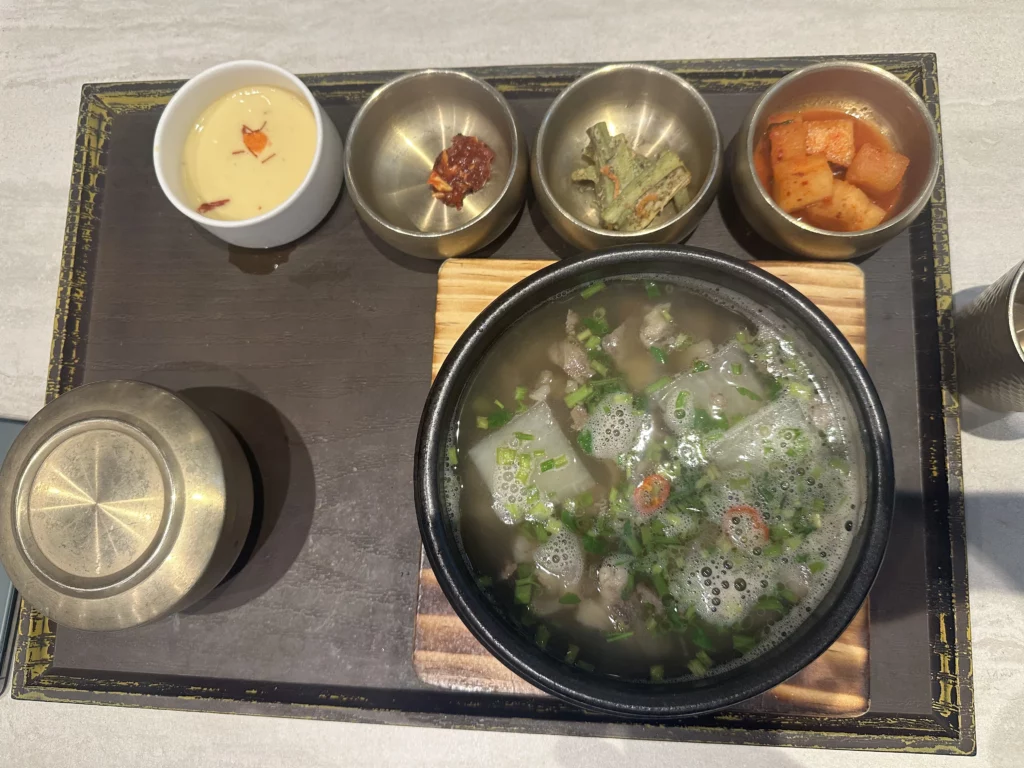
For those seeking a gentler experience, the Minari Malgeun Gomtang (미나리 맑은 곰탕) — clear beef soup with Korean dropwort — is the quiet revelation on the menu. Gomtang (곰탕) is a traditional clear Korean beef soup achieved by simmering beef bones and cuts at a steady temperature for many hours, without the milky richness of seolleongtang. The result is a crystalline golden broth, clean but unmistakably deep, carrying a warm mineral sweetness that feels almost medicinal in the best possible way.
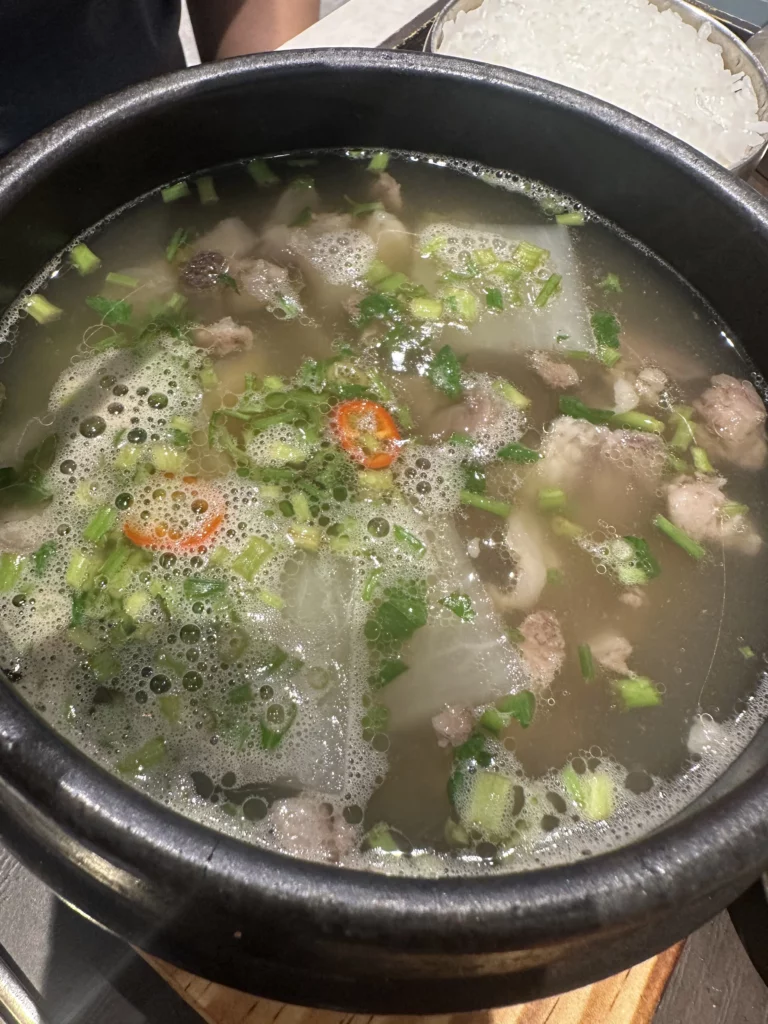
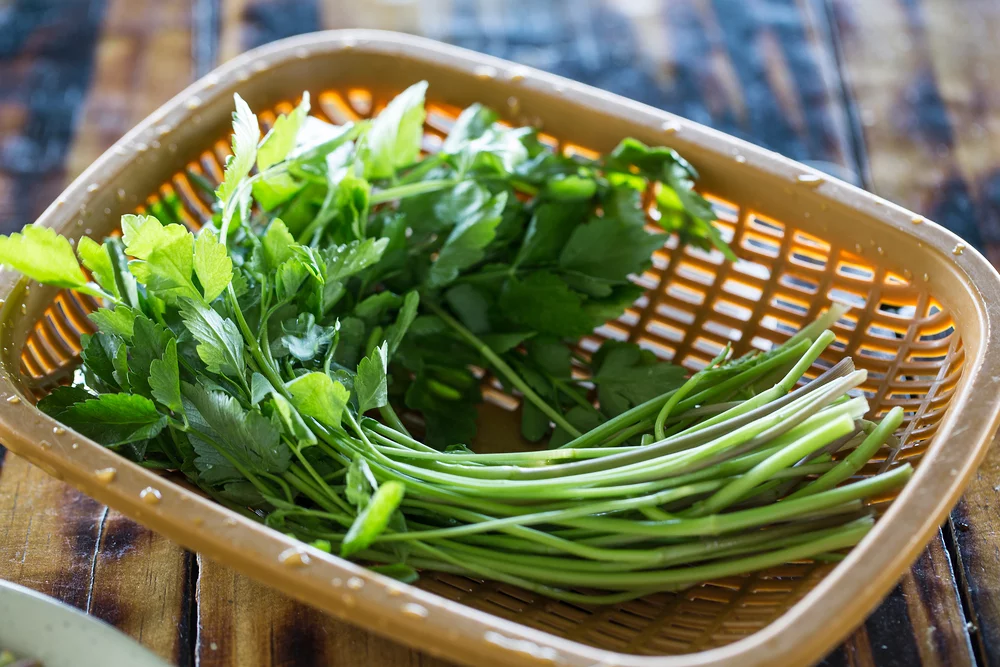
The addition of minari (미나리, Korean dropwort) introduces a green, slightly herbal freshness — similar to watercress or flat-leaf parsley in fragrance, but with a distinctly Korean vegetal character. For a deeper understanding of Korean beef cuts and the techniques behind classic Korean beef soups, this ingredient guide is an excellent companion read. Spice level: 1/10. This dish is universally accessible and ideal for children or travelers with sensitive palates.
Abalone Porridge with Pine Mushroom — 전복 솔버섯 죽
Perhaps the most distinctly Korean item on the menu is the Jeonbok Sol-beoseot Juk (전복 솔버섯 죽) — a slow-cooked rice porridge incorporating the prestige ingredients of Korean abalone (전복, jeonbok) and sol-beoseot (솔버섯), the pine mushroom prized for its resinous, woodsy fragrance. The result is a porridge of remarkable subtlety: ivory-colored, silky, faintly oceanic, and deeply soothing.
In Korean culinary tradition, jeonbokjuk has long been considered a food of care and restoration — historically prepared for patients recovering from illness, for new mothers after childbirth, and for honored guests. At Jayeon, this dish is served with the ceremony it deserves. The abalone, described in Korean food culture as the "Emperor of the Sea," provides tender, slightly chewy slices with a rich iodine character. The pine mushroom layers in an aromatic earthiness that elevates the porridge far beyond simple comfort food. Spice level: 0/10. Seasonings are minimal, allowing the premium ingredients to speak for themselves.
Grilled Salted Mackerel and Spicy Soft Tofu Stew
In keeping with Jayeon’s approach of considering international visitors’ palates, the menu also includes classic Korean bansang (반상) set meals built around grilled salted mackerel (고등어구이) and a range of traditional stews. The mackerel arrives golden-skinned, with flesh that pulls away in clean, moist flakes, served alongside a bowl of steamed rice and a rotating selection of banchan side dishes.
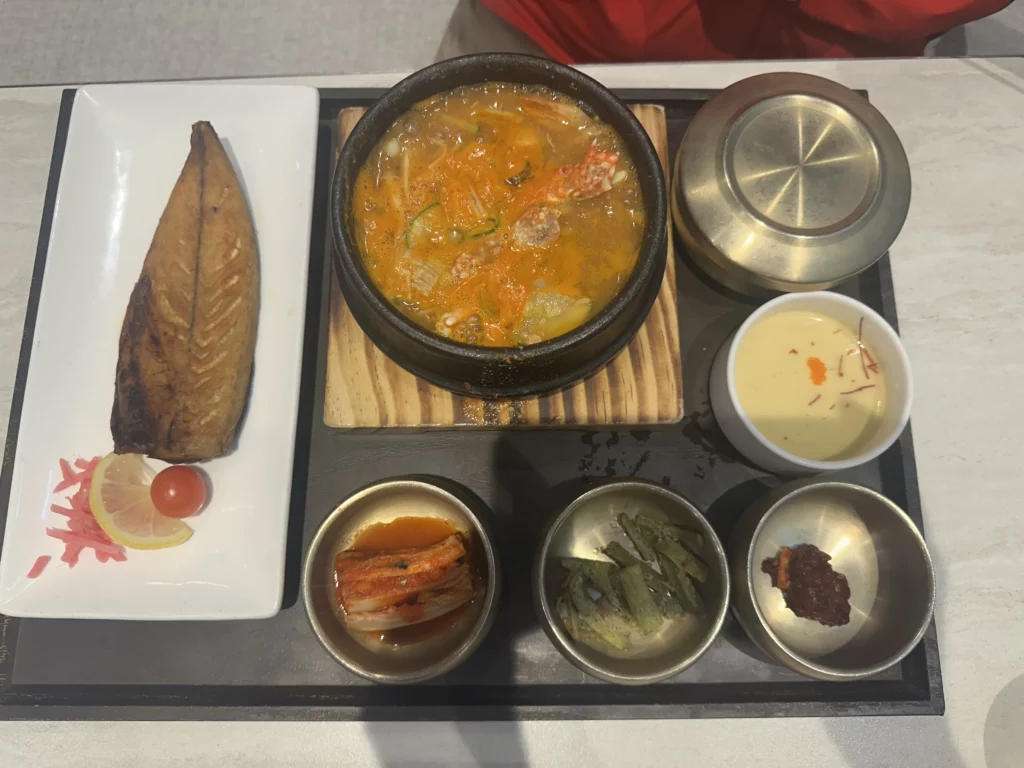
For spice-lovers, the Eolkeun Myeongnan Sundubu Jjigae (얼큰 명란 순두부찌개) — a spicy soft tofu stew with mentaiko (pollock roe) — is a bubbling, fiery earthenware bowl of pure Korean comfort. Sundubu (순두부), the impossibly soft, uncurdled tofu that anchors this dish, carries flavor like a sponge, absorbing every nuance of the bold gochugaru broth. To appreciate the depth behind this classic dish, discover the full story of Korean spicy soft tofu stew. Spice level: 6–7/10.
Key Ingredients That Define the Flavors
Three ingredients recur throughout Jayeon’s menu and are worth understanding before you order:
- Gochugaru (고추가루) — Korean red chili flakes. Not to be confused with cayenne, gochugaru delivers a warm, slightly fruity heat that builds slowly rather than overwhelming. Its flavor profile is sweeter and more complex than Western chili powders, and it forms the backbone of the spicy beef soup and soft tofu stew.
- Minari (미나리) — Korean dropwort. A semi-aquatic herb resembling water parsley, with a clean, slightly grassy fragrance. Rich in vitamins C and A, it is prized both as a flavoring and a palate cleanser in Korean cooking, particularly in clear soups.
- Jeonbok (전복) — Korean abalone. Harvested primarily from the coastal waters of Wando and Jeju Island, Korean abalone offers a tender, faintly sweet texture. Rich in protein, iron, and zinc, it is considered one of Korea’s most restorative ingredients — its appearance on a menu signals a restaurant’s commitment to premium quality.
Regarding fermented elements: while Jayeon’s style is cleaner and more refined than a traditional home kitchen, fermented accompaniments such as kimchi and doenjang-based dipping sauces inevitably appear in the bansang set meals, delivering the probiotic depth and umami complexity that distinguishes Korean cuisine from any other in the world.
FAQ: Everything You Need to Know Before You Visit
What makes Jayeon NATURE uniquely Korean?
Jayeon’s philosophy is rooted in banga cuisine (반가 음식) — the culinary tradition of Korea’s noble Joseon-era families. Unlike the boldly spiced, communal grilling culture most foreigners associate with Korean food, banga cuisine emphasizes balance, restraint, and seasonal ingredients. Dishes are presented in the formal bansang style: rice, soup, and multiple small side dishes arranged in a considered ensemble. For international travelers who may only experience Korean food once, Jayeon offers a window into the cuisine’s quieter, more refined register — something rarely encountered outside Korea.
What are the key ingredients that create the flavor?
Three ingredients create Jayeon’s signature flavor identity: the gochugaru-laced beef broth in the spicy soup, the slow-simmered bone stock in the clear gomtang, and the premium abalone in the porridge. The kitchen’s approach to beef broth — extracted over long hours from bones and brisket — is detailed in the complete guide to Korean beef and its preparation techniques. Each ingredient is chosen to honor the Korean principle that the best flavors come from patience, not complexity.
How spicy is the food at Jayeon, and what’s the overall flavor profile?
The menu ranges from completely non-spicy (0/10) options like the abalone porridge and clear gomtang, to moderately-to-strongly spicy (5–7/10) items like the beef haejangguk and mentaiko soft tofu stew. Primary flavor notes across the menu are umami, savory, and subtly sweet — driven by long-simmered stocks rather than aggressive seasoning. Dishes are served hot. First-time visitors wary of spice should begin with the clear gomtang or abalone porridge, then venture to the spicier soups once settled.
What should first-time visitors know?
Korean set meals (bansang) at Jayeon arrive with multiple small side dishes (banchan) that are meant to be shared and eaten between bites of the main dish. Do not order one of each item — the bansang set is designed as a complete, balanced meal in itself. Koreans traditionally use both chopsticks (for side dishes) and a flat-bottomed spoon (for rice and soup). Mixing rice directly into your soup bowl — frowned upon in some cultures — is entirely normal and encouraged in Korean dining. Reservations are not typically required for hall seating, but the three private dining rooms should be arranged in advance for groups. Jayeon’s guide to understanding Korean banchan side dishes is highly recommended reading before your first visit.
Practical Visitor Information
DetailInformation
Location
Terminal 1, 4F, Food Street / Terminal 2, 4F
Operating Hours
Daily 06:00 – 22:00 (Last order 21:30)
Seating
150 seats (T1) including 3 private dining rooms
Price Range
Approx. ₩15,000 – ₩35,000 per person
Operator
Walkerhill Hotels & Resorts
Discount
10% for Incheon Airport staff (permanent)
Jayeon is accessible after clearing security in the departures area, making it suitable for pre-boarding meals. For transit passengers, Terminal 1 and Terminal 2 are connected by the Airport Transit Train (free).
For broader context on Korean culinary culture and dining traditions, Korea’s official tourism resource offers excellent background for first-time visitors.
The Best Korean Meal in Any Korean Airport — And That’s Saying Something
For most international travelers, Incheon Airport is their first or last encounter with Korean soil. Jayeon NATURE understands this responsibility and rises to it. The restaurant does not aim to be the fastest, cheapest, or flashiest option in the terminal. It aims instead to be the most Korean — unhurried, generous in small gestures, anchored in a culinary tradition that views every meal as a form of care.
Whether you’re arriving exhausted from a transatlantic flight and seeking the restorative warmth of spicy beef soup, or departing Korea for the last time and craving one final bowl of something that tastes of home, Jayeon offers a rare kind of airport experience: food made with genuine intention, in a space designed for the human being rather than the hurried passenger.
Plan your meal at Jayeon NATURE on your next transit through Incheon Airport. Arrive with a few extra minutes, sit by the window, and let Korea’s most elegant airport Korean restaurant send you off — or welcome you back — the right way.
Location
Terminal 1, 4F, 272 Gonghang-ro, Jung-gu, Incheon, KR
Reviews
5.0
1 reviews
5
100%
4
0%
3
0%
2
0%
1
0%
Loading reviews...
Related Recipes

Meat & Poultry
Ttukbaegi Bulgogi (Korean Sizzling Beef Stew in a Hot Stone Pot)
There’s a particular kind of comfort in lifting the lid off a bubbling ttukbaegi bulgogi . Steam curls upward, the...

Rice
Bulgogi Gimbap (Korean Beef Gimbap)
If you’ve ever bitten into a perfectly rolled gimbap and experienced that harmonious blend of savory-sweet marinated beef, nutty sesame...

Soups
Naengi Doenjang Jjigae (Soybean Paste Stew with Shepherd’s Purse)
Naengi Doenjang Jjigae, or soybean paste stew with shepherd’s purse, is a seasonal Korean dish that captures the freshness of...


Gukbap
Neungdong Minari Seongsu: Minari Gomtang Guide
Seongdong-gu, Seoul 42 Yeonmujang-gil,
5

Bibimbap
Sonsuheon: Best Korean Restaurant in Incheon Airport?
271 Gonghang-ro, Jung-gu, Incheon West Side (Public Area), 4th Floor, Incheon Airport Terminal 1 (T1)
5

Gukbap
Hadongkwan Myeongdong: 80 Years of Michelin Hanwoo Beef Soup
Jung-gu, Seoul 12, Myeongdong 9-gil
5

Beef
Chowon Korean BBQ: Gangnam's Hidden Gem for Marinated Sirloin and Premium Beef Tongue
Gangnam-gu, Seoul, Republic of Korea 62-3 Nonhyeon-dong
5