


Ssal-tteok (Rice-Based Tteokbokki Rice Cakes)
Walk past any tteokbokki vendor in Sindang-dong on a winter evening, and you will notice the rice cakes before you smell the sauce. They are short, thick, slightly translucent — pale ivory cylinders cut at a precise angle, glossy with red gochujang. These are ssal-tteok (쌀떡), the rice-based tteokbokki cakes that have become the standard for any Korean cook who insists on doing this dish properly. They are not the long, slim garae-tteok you see floating in tteokguk, and they are not the chewy white circles found in many imported supermarket packs — those are often mil-tteok (밀떡), the wheat-flour cousin. Understanding the difference is the first step to cooking tteokbokki the way it is cooked in Korea.
This guide is a focused, technical companion to our broader Korean Rice Cake (Tteok) ingredient guide, which surveys the full ceremonial and cultural span of tteok. Here, we go narrower and deeper — into the single category of rice cake that powers Korea’s most beloved sauce-driven dishes.

Table of Contents
- What Is Ssal-tteok? A Precise Definition
- Ssal-tteok vs. Mil-tteok: The Great Tteokbokki Debate
- Why Mepssal (Non-Glutinous Rice) Is the Heart of Ssal-tteok
- How Ssal-tteok Is Actually Made
- How to Choose Quality Ssal-tteok at a Korean Grocer
- How Do You Cook Ssal-tteok So It Stays Chewy?
- Beyond Tteokbokki: The Many Lives of Ssal-tteok
- Is Ssal-tteok Actually Good for You?
- Dr.’s Nutritional Insight
- Final Thoughts
What Is Ssal-tteok? A Precise Definition

Ssal-tteok (쌀떡) literally means "rice tteok" — ssal (쌀) for uncooked rice grain, tteok (떡) for rice cake. The name exists for a reason: it draws a line in the sand against mil-tteok (밀떡, "wheat tteok"), and specifies that the cake in question is built from real rice rather than wheat starch.

In day-to-day Korean usage, "ssal-tteok" almost always refers to the short, cylindrical rice cakes — roughly 4–6 cm long, 1.5–2 cm thick — engineered specifically for sauce-based cooking. The longer cylindrical version, garae-tteok (가래떡), is the same dough family but cut into long ropes traditionally sliced into ovals for tteokguk soup at Lunar New Year. When a Korean recipe calls for tteokbokki-yong tteok (떡볶이용 떡, "tteok for tteokbokki"), it means ssal-tteok in its short, sauce-ready form.
This is a fundamentally different category from the celebratory rice cakes — songpyeon, injeolmi, sirutteok, baekseolgi — surveyed in our 15 Korean rice cake types guide. Ssal-tteok is the everyday, sauce-absorbing, weeknight workhorse of the Korean kitchen.
Ssal-tteok vs. Mil-tteok: The Great Tteokbokki Debate
If you ask a Korean cook which tteokbokki they grew up loving, their answer almost always begins with this distinction.

| Feature | Ssal-tteok (쌀떡) | Mil-tteok (밀떡) |
|---|---|---|
| Base ingredient | Non-glutinous rice (mepssal) | Wheat flour |
| Texture | Dense, firm, slow chew | Softer, springier, almost noodle-like |
| Sauce absorption | Slow, gradual | Fast, deep |
| Cooking time | 7–10 minutes | 4–6 minutes |
| Best for | Slow-simmered stews, royal-style tteokbokki, sticky home sauce | Quick street-style tteokbokki, school-snack tteokbokki |
| Gluten | Naturally gluten-free | Contains gluten |
Mil-tteok rose to popularity during the rice-shortage years of mid-twentieth-century Korea, when wheat flour was abundant and cheap. According to the Korea Tourism Organization, the now-iconic Sindang-dong Tteokbokki Town built its identity on this exact moment — Ma Bok-rim is widely credited with creating modern gochujang tteokbokki in the 1950s using whatever rice cakes were available. Today, the ssal-tteok vs. mil-tteok preference is regional, generational, and deeply personal: many Seoulites swear by mil-tteok for street-style tteokbokki, while traditionalists and home cooks across the country favor ssal-tteok for its richer chew and clean rice flavor.

For the slow-simmered, sauce-clinging style that dominates most home cooking — and our spicy tteokbokki recipe — ssal-tteok is the unambiguous choice.
Why Mepssal (Non-Glutinous Rice) Is the Heart of Ssal-tteok

Korean rice cakes draw on two grains: mepssal (멥쌀), the everyday short-grain non-glutinous rice eaten with meals, and chapssal (찹쌀), the elastic glutinous rice used for taffy-textured cakes like injeolmi. (For the chapssal side of the family, see our Korean glutinous rice ingredient guide.)

Ssal-tteok is made almost exclusively from mepssal, and the choice is structural. Glutinous rice is too elastic — it produces the bouncy, taffy-stretch chew that works beautifully in injeolmi but collapses into mush when simmered for ten minutes in a sauce. Non-glutinous mepssal, by contrast, holds its cylindrical shape through prolonged cooking. Its lower amylopectin and higher amylose content allow it to gelatinize, retrograde during cooling, and reheat without falling apart. The result is the signature ssal-tteok bite — dense outside, tender inside, satisfyingly jjolgit-jjolgit (쫄깃쫄깃).
This is also why ssal-tteok behaves differently from any East Asian rice cake outside Korea. Japanese mochi, made from glutinous rice, dissolves quickly in soup. Chinese nián gāo uses different starch ratios and gels rather than retaining cylindrical shape. The cylindrical-mepssal-extrusion approach is distinctly Korean.
How Ssal-tteok Is Actually Made

Whether artisanal or industrial, the production sequence follows the same logic:
- Soaking. Mepssal is soaked in cold water for 4–8 hours.
- Grinding. The hydrated rice is ground twice into a fine, slightly damp flour.
- Steaming. The flour is steamed in a siru (시루) for 20–30 minutes until translucent.
- Pounding or kneading. The hot steamed mass is pounded — traditionally with wooden mallets, today usually with a high-torque mixer — until smooth and cohesive. This is the step that develops the chewy structure.
- Extrusion. The dough is forced through a cylindrical die to form long ropes, then cut to length with a high-tension wire.
- Cooling and packaging. Cooled cakes are vacuum-sealed for shelf stability.
Modern Korean tteok factories — the kind whose vacuum packs you’ll find at Korean grocers abroad — perform all of this in a single continuous line. The best small tteok-jip (떡집), traditional rice-cake shops, still pound their dough for added chew and sell their ssal-tteok same-day. If you can find day-of ssal-tteok, buy it: the difference in texture is dramatic.
How to Choose Quality Ssal-tteok at a Korean Grocer
A quick sourcing checklist:
- Read the ingredient list. True ssal-tteok lists rice (쌀) — usually as mepssal or non-glutinous rice — as the first and only main ingredient, with water and a small amount of salt. If you see wheat flour (밀가루) or modified starch near the top, it is mil-tteok or a hybrid.
- Check vacuum integrity. The bag should be tight and uninflated. A puffy package signals fermentation or bacterial activity.
- Look at the color. Quality ssal-tteok is a soft ivory white, slightly translucent. Pure chalk-white pieces often indicate excess starch added for cost.
- Date matters. Refrigerated, fresh ssal-tteok keeps about a week; frozen, up to a month. Older cakes harden and lose their elastic core.
- Specify the cut. For tteokbokki, ask for tteokbokki-yong (떡볶이용); for soup, ask for sliced tteokguk-yong (떡국용) or whole garae-tteok to slice yourself.
How Do You Cook Ssal-tteok So It Stays Chewy?
Ssal-tteok rewards a few small disciplines:
- Soak refrigerated tteok in cold water for 10–20 minutes before cooking. This rehydrates the surface and prevents brittleness.
- For frozen tteok, thaw fully first. Dropping frozen tteok directly into hot sauce shocks the surface into mush before the interior warms through.
- Simmer rather than boil. A gentle simmer (around 90 °C) lets sauce penetrate without breaking the cylinder’s surface.
- Don’t over-stir. Ssal-tteok bruises. A gentle fold once or twice during cooking is enough.
- Add a splash of water or broth at the end. As the sauce reduces and the cakes absorb liquid, the dish can tighten too far. A loosening splash restores gloss.
For dishes like budae jjigae (Korean army stew) where ssal-tteok shares the pot with noodles, kimchi, and processed proteins, add the cakes only in the final 5–7 minutes — they should arrive at the table tender, not gummy.
Beyond Tteokbokki: The Many Lives of Ssal-tteok
While tteokbokki is the headline act, ssal-tteok carries an entire repertoire:

- Tteokguk (떡국). Thin oval slices of garae-tteok in a clear beef or anchovy broth — the obligatory dish of Lunar New Year. The whiteness, as documented in Korea.net’s cultural archive, symbolizes purity and a fresh annual beginning. Our tteokguk recipe walks through the proper soak-and-broth technique.

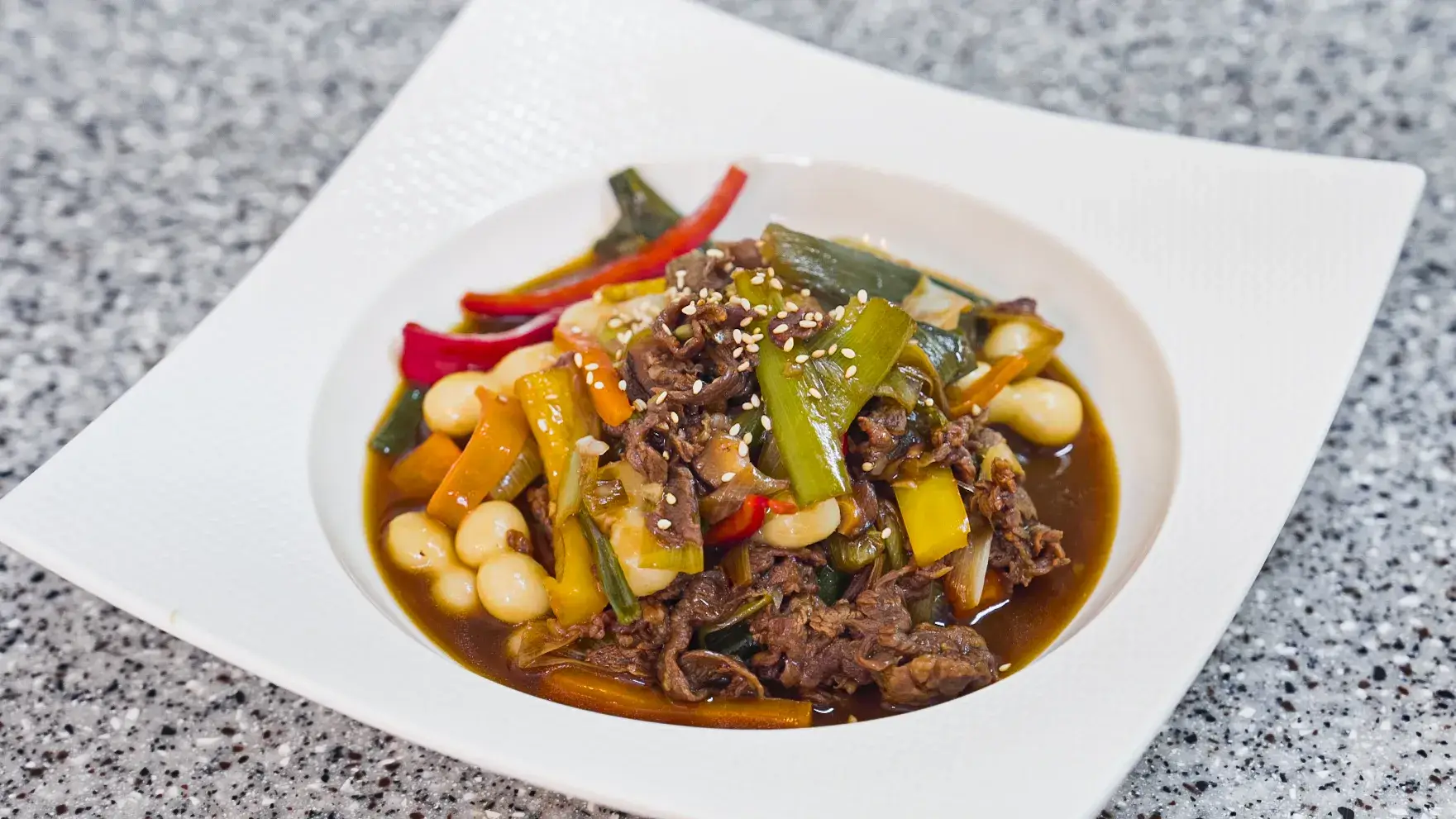
- Gungjung tteokbokki (궁중떡볶이). The royal court ancestor of modern tteokbokki — a soy-based stir-fry with sesame oil, beef, and seasonal vegetables. Discover the classical preparation in our gungjung tteokbokki guide.

- Rose tteokbokki (로제떡볶이). The viral creamy-spicy reinterpretation; ssal-tteok’s slow sauce absorption is what keeps the cream sauce from turning gluey. See our rose tteokbokki recipe.

- Tteok-kkochi (떡꼬치). Skewered, pan-fried, brushed with sweet-spicy sauce — Korean street food at its purest.
- Stir-fries and braises with pork, kimchi, or seafood, where the cakes serve as both starch and texture.
A practical note: ssal-tteok scales beautifully. A 500 g pack feeds 2–3 as a snack or 1–2 as a meal. Buy a kilogram, freeze in flat single-layer portions, and you are minutes away from a tteokbokki on any weeknight.
Is Ssal-tteok Actually Good for You?
A surprising answer hides inside an ordinary cylinder of ssal-tteok — and it has nothing to do with sauce.
The way ssal-tteok is manufactured — rice is steamed, then cooled (sometimes for hours, sometimes for days during refrigeration or freezing), then reheated at the moment of cooking — happens to map almost perfectly onto the laboratory protocol that nutrition scientists use to study resistant starch type 3 (RS3). When cooked rice cools, a fraction of its digestible starch undergoes a structural change called retrogradation, recrystallizing into a form that resists digestion in the small intestine. Reheating does not undo this change. The starch remains partially "resistant" — releasing glucose into the bloodstream more slowly than freshly cooked rice.
For a dish like tteokbokki, where ssal-tteok is the principal carbohydrate, this matters. The same plate of rice eaten as steamed bowl-rice and as ssal-tteok produces measurably different glucose curves — and the gentler curve has downstream consequences not just for metabolic health, but, increasingly, for skin.

Ssal-tteok is not glamorous. It does not arrive at the table on a celebratory tray like songpyeon, nor does it get dusted with golden soybean powder like injeolmi. It shows up in red sauce, in cloudy soup, on a stick, in school-canteen lunches and late-night cab-ride snacks. Its job is to be the most reliable chew in the Korean kitchen.
But within that humble brief lives an entire argument about ingredient honesty. Choosing ssal-tteok over mil-tteok — when both sit beside each other in the freezer aisle — is choosing the longer cooking time, the cleaner rice flavor, the tradition that runs from the siru steamers of the Three Kingdoms period to the high-pressure extrusion line in a modern Korean factory. And, as it turns out, it may also be choosing the gentler glucose curve that keeps your skin’s collagen quietly intact.
Have a favorite tteokbokki style — sweet, spicy, royal, or rosé? The next time you cook one, reach past the soft-and-springy mil-tteok package and pick up real ssal-tteok. Share this guide with anyone who has ever wondered why their homemade tteokbokki doesn’t quite taste like the Sindang-dong original. The answer, almost always, is in the rice.
🩺 Dr.’s Nutritional Insight
Ssal-tteok carries a quiet metabolic advantage rooted in its production cycle: rice is steamed, cooled, and reheated — the exact retrogradation sequence that converts digestible starch into resistant starch (RS3). A clinical study published in Nutrition & Diabetes (Nature), 2022 found that cooled-and-reheated rice produced a significantly lower postprandial glucose AUC (135 vs. 336 mmol/L · 180 min) and a smaller maximum glycemic increase (2.7 vs. 3.9 mmol/L) compared with freshly cooked rice. The skin relevance is direct: chronic postprandial glucose spikes drive the formation of advanced glycation end-products (AGEs), which cross-link dermal collagen and elastin and are now considered a leading non-UV contributor to wrinkle formation, loss of elasticity, and dull complexion (International Journal of Molecular Sciences, 2023). Choosing ssal-tteok over freshly cooked white rice is, in metabolic terms, choosing a flatter glucose curve — and a flatter glucose curve is, in dermatological terms, a quieter glycation environment for collagen.
Beauty Benefit: Anti-Aging ✨ | Skin Health 🌿
Nutritional insight provided by Dr. James Lee, Board-Certified Plastic Surgeon
Related from K-Beauty Kitchen: how Korean food fits together for skin, aging and recovery.
Reviews (0)
Join the Taste Korean food community and add comments.
Related Recipes

Spicy Tteokbokki
Spicy tteokbokki is more than just a street snack — it’s a bold, comforting taste of Korean culture. This guide dives deep into the essentials…

Budae Jjigae (Korean Army Stew)
Few dishes capture the spirit of Korean resilience quite like Budae Jjigae. This bubbling, spicy stew transforms humble ingredients—Spam, sausages, kimchi , and instant noodles—into…
Gungjung Tteokbokki (Royal Tteokbokki)
Before fiery gochujang-drenched rice cakes became Korea’s beloved street food, there was a refined, savory dish gracing the tables of Joseon Dynasty royalty. Gungjung Tteokbokki…

Korean Sesame Oil Seed Origin: Made vs Grown
“Korean-style,” “made in Korea,” “Korea-grown sesame,” and “Yecheon Chamgireum (예천참기름) — protected regional sesame-oil name” are four different claims. Manufacturing country and farm origin are not the same thing, so a bottle pressed in Korea does not by itself prove the sesame was grown there. This guide shows what a label actually proves and how to read the ingredient-origin statement before trusting a regional name.

Korean Ramyeon: The Complete Guide to Korea’s Instant Noodles
Korean ramyeon has grown from a post-war convenience food into one of the most recognizable pillars of modern Korean cuisine, and this guide covers everything a curious cook needs to know about Korean ramyeon and Korean instant noodles. Whether you’re stocking a pantry for the first time or trying to recreate a dish you saw in a K-drama, understanding the different varieties, flavors, and traditions behind ramyeon makes every bowl more rewarding.

Korean Noodle Types: A Complete Guksu Guide
Korean noodle types aren’t a single product — they’re a toolkit. Somyeon, jungmyeon, kalguksu, buckwheat memil-myeon, and naengmyeon sari each solve a different cooking problem, and Korean home cooks reach for the right noodle the way a baker reaches for the right flour. For readers new to Korean cooking, understanding these Korean noodle types for traditional dishes makes it far easier to shop confidently and recreate authentic bowls at home.

Korean Black Garlic: Taste, Uses, and How It’s Aged
Black garlic — heukmaneul (흑마늘) — is ordinary garlic held for weeks in controlled heat and humidity until the cloves turn jet black, soft, and molasses-sweet. It is not a variety but a change of state, and the allicin that makes raw garlic sharp falls away with it.