1st Floor 8 Hangang-daero 62ga-gil, Yongsan District, Seoul
Editor: 안주은
Interior04
Food06
Menu01
Overview
+82 02-797-4488
WiFi Provided
Indoor Seating Only
Electronic Payment accepted: American Express, Master Card, Visa
Introduction
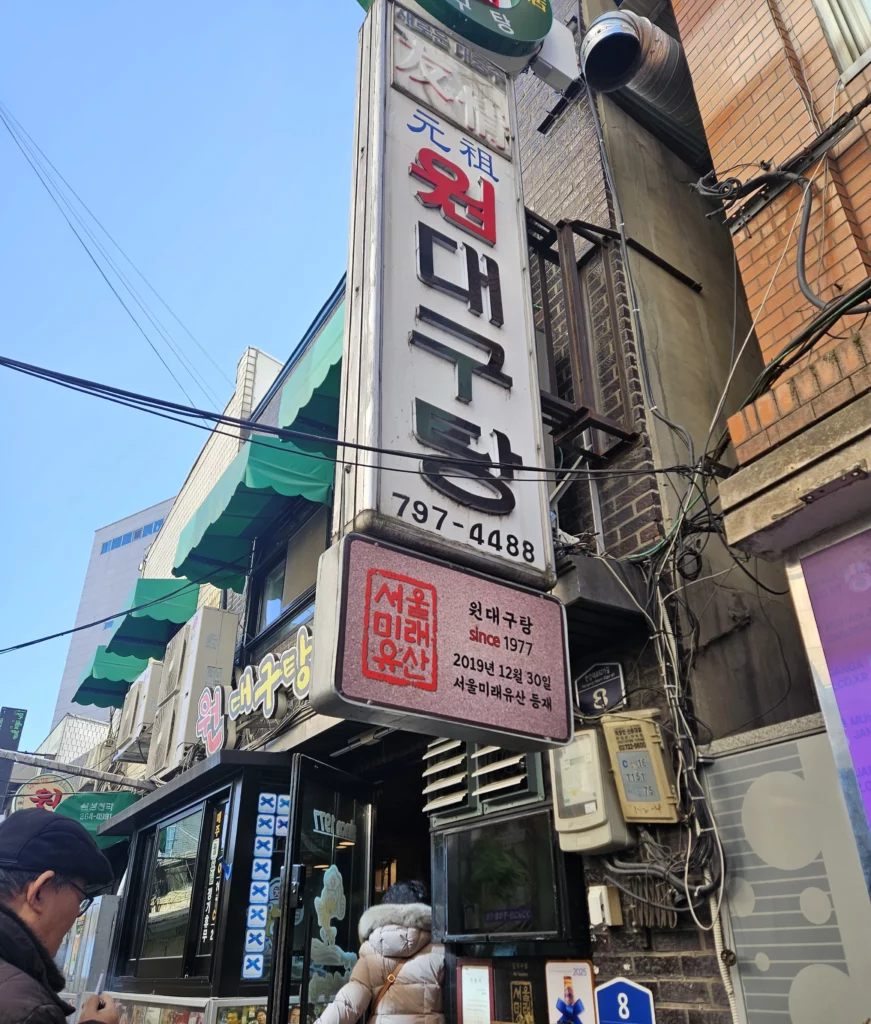
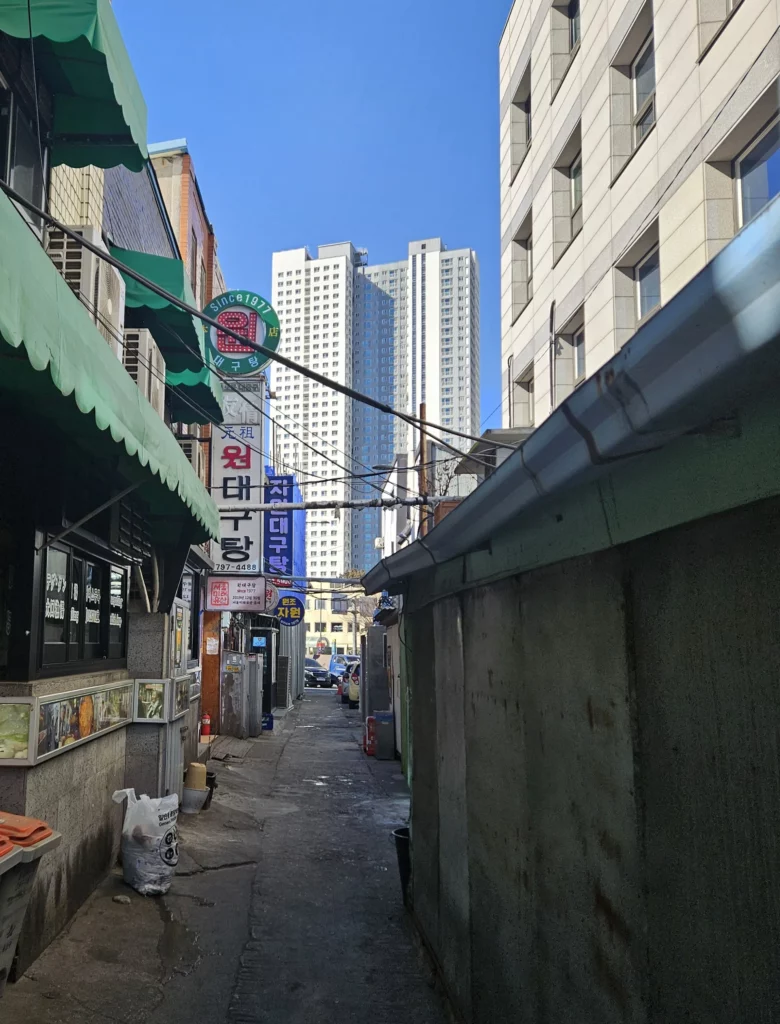
Open since 1979 and now operated by its second-generation owner, Won Daegu-tang is the undisputed original of Samgakji’s famous Daegu-tang Alley — a narrow back street where the aroma of simmering fish broth has drawn loyal patrons for over four decades.
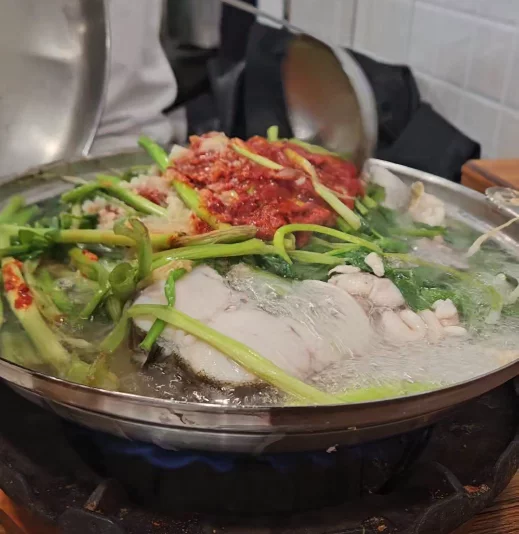
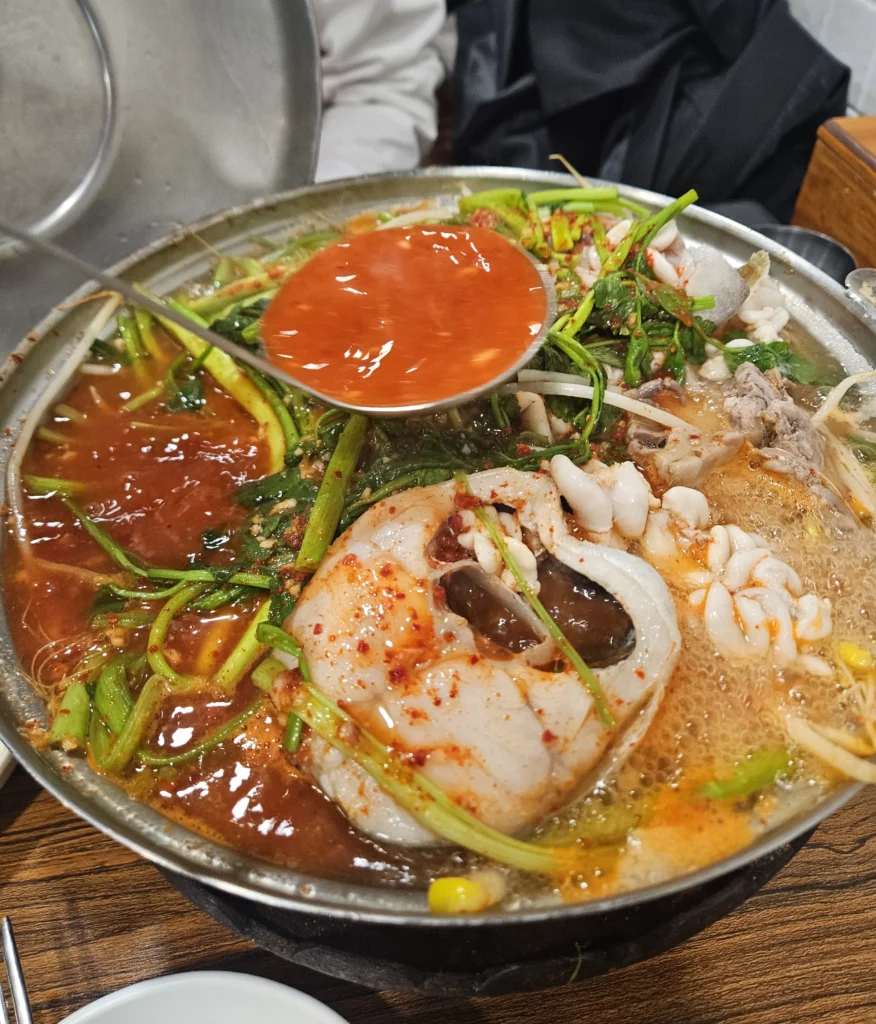
Steam curls from a bubbling stone pot, carrying the clean, briny scent of fresh cod mingled with fragrant minari and earthy bean sprouts. The broth shimmers a fiery red — or, if you prefer, a milky, translucent white — and tender codfish beneath a generous pile of vibrant greens. This is daegu-tang (대구탕), Korea’s beloved cod fish stew, and no restaurant in Seoul has mastered it quite like Won Daegu-tang (원대구탕) in the Samgakji neighborhood of Yongsan-gu.
Operating hours
Tue, Wed, Thu, Fri, Sat, SunAM 10:00 - PM 10:00
Menu
Editor's Detail
The History Behind Seoul’s Original Cod Fish Stew Restaurant
Won Daegu-tang opened in 1979 in a quiet alley behind what is now Samgakji Station, initially serving local workers and soldiers stationed at the nearby military base. The restaurant became so popular that competitors soon opened alongside it, and the entire lane gradually became known as Daegu-tang Golmok (대구탕골목) — Cod Soup Alley. Yet even after more than four decades and the emergence of several neighbors, Won Daegu-tang consistently draws the longest lines and the most devoted regulars.
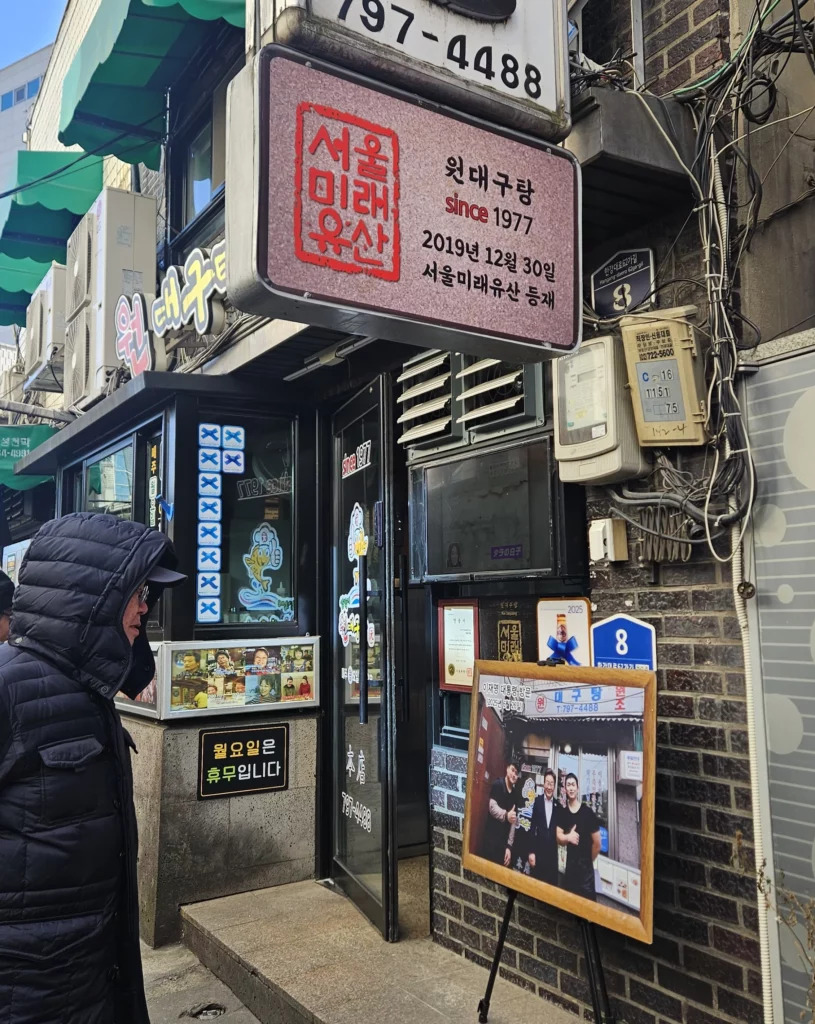
The restaurant’s founder passed the business to second-generation owner Son Seok-ho in 1994, who has maintained the original recipe while earning recognition from multiple Korean culinary institutions. Won Daegu-tang has been designated a Seoul Future Heritage site, a program that preserves cultural assets representing Seoul’s living history, and has received the prestigious Blue Ribbon award. The restaurant has appeared on numerous Korean food television programs, including Wednesday Food Talk (수요미식회) and the celebrated Heo Young-man’s Baekban Gihaeng (백반기행).
Most recently, in June 2025, the President of South Korea made an unannounced visit to Won Daegu-tang for lunch, drawing national media attention and further cementing its reputation as a restaurant that represents the honest, hearty spirit of Korean home-style cooking. The presidential visit reflected not just the quality of the food but the cultural significance of a neighborhood institution that has fed generations of Seoul residents.
What Makes Won Daegu-tang’s Seafood Stew Uniquely Korean?
Daegu-tang occupies a special place in Korean dining culture. Unlike the bold, fermented-paste-heavy stews that many associate with Korean cuisine — dishes that rely on gochujang or doenjang for their foundational flavors — daegu-tang celebrates the natural sweetness and delicacy of fresh cod. The word "daegu" (대구) literally means "large mouth" in Korean, a reference to the cod’s distinctive wide jaw, and "tang" (탕) simply means "stew" or "hot soup."
In Korean food culture, fish stews like daegu-tang serve as both everyday comfort food and a trusted remedy for hangovers, similar to how dried pollack soup functions as Seoul’s go-to morning-after cure. The refreshing, clean broth is believed to settle the stomach and replenish the body after a night of soju. But daegu-tang is also simply beloved for its deeply satisfying flavor — a bowl that warms without weighing you down, making it popular year-round despite being especially comforting during Seoul’s cold winters.
What distinguishes Won Daegu-tang from similar preparations elsewhere is the restaurant’s uncompromising use of whole, fresh cod. Large chunks of fish — flesh, roe (곤이, gonni), and optionally head and innards — are cooked in a broth loaded with Korean radish, fresh minari (Korean water celery), bean sprouts, and tofu. The result is a stew that feels generous and abundant, far removed from the thin, meager fish soups that international visitors might expect.
Three Cod Fish Stew Styles: How to Choose Your Flavor
One of Won Daegu-tang’s defining features is the ability to choose from three distinct flavor profiles, each offering a different experience of the same premium cod. This flexibility allows both adventurous and cautious eaters to find their ideal bowl.
Maeun-tang (매운탕) — Spicy Cod Stew: The most popular option, this version features a vibrant red broth seasoned with gochugaru (Korean red pepper flakes) and garlic. The heat is assertive but not overwhelming, allowing the natural sweetness of the cod to remain the primary flavor. Many regulars consider this the definitive Won Daegu-tang experience.
Malgeun-tang (맑은탕) — Clear Cod Stew: Also called daegu jiri (대구지리), this gentle, milky-white broth version highlights the pure, unadulterated flavor of the fresh cod. With no chili heat whatsoever, it reveals subtle layers of umami from the fish and the clean sweetness of Korean radish. This style is ideal for anyone sensitive to spice or wanting to taste the cod in its most natural expression.
Naejang-tang (내장탕) — Innard Stew: For more adventurous diners, this variation emphasizes the rich, complex flavors of cod innards and head meat. The organs add a deeper dimension of umami and a slightly richer mouthfeel. Regulars who know the menu well often order "ban-ban seokeo" (half-and-half), requesting a mix of regular cod flesh with roe and innards for maximum variety in a single pot.
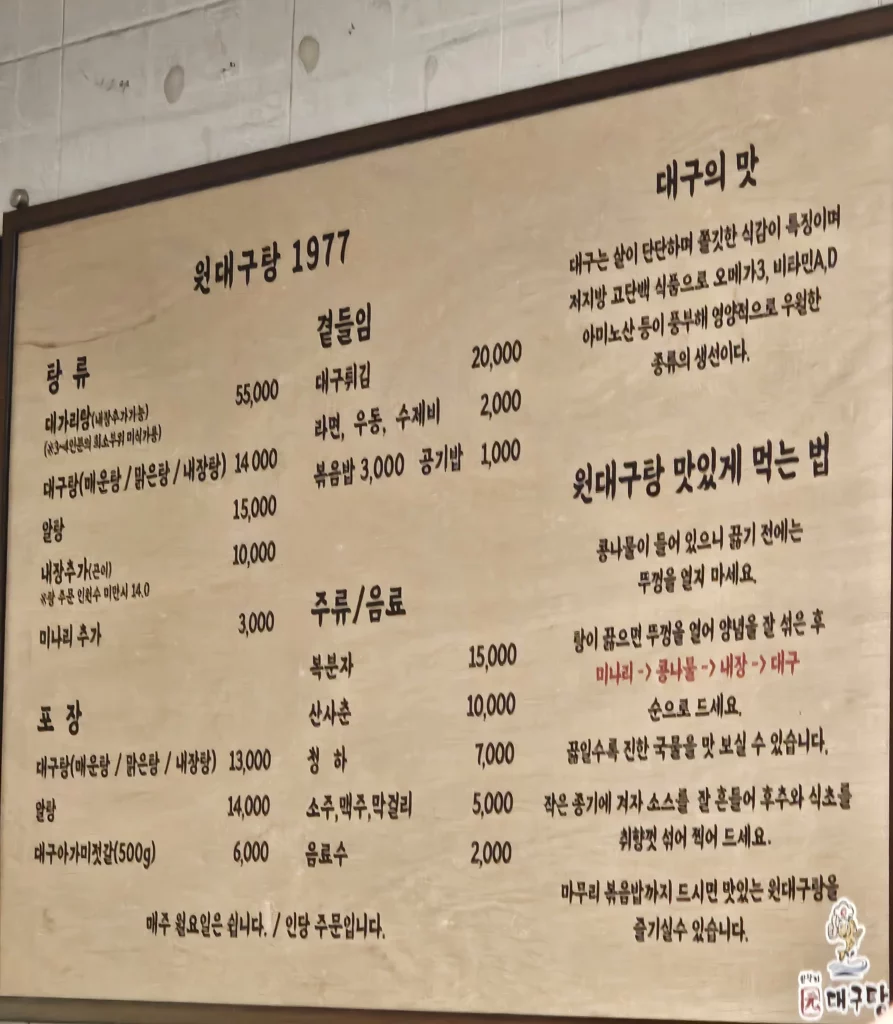
All three versions are priced at ₩14,000 per person with a minimum order of two servings.
What Are the Key Ingredients That Create This Flavor?
Won Daegu-tang’s signature taste comes from the interplay of three essential ingredients that define its character.
Fresh Pacific Cod (대구, daegu): The undisputed star of the dish. Won Daegu-tang uses plump, fresh cod that delivers soft, flaky white flesh with a naturally sweet, delicate flavor. Cod is mild enough to absorb the broth’s seasoning while maintaining its own identity. Nutritionally, it is an excellent lean protein source, low in fat and rich in omega-3 fatty acids, vitamin B12, and phosphorus — making the stew as nourishing as it is satisfying.
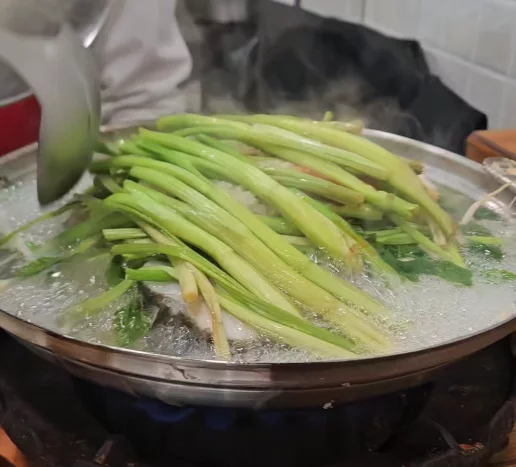
Korean Water Celery (미나리, minari): Heaped generously on top of every pot, minari is the aromatic herb that gives Won Daegu-tang its distinctive freshness. This aquatic plant offers a peppery, slightly bitter bite that cuts through the richness of the fish broth, functioning as a natural palate cleanser with every spoonful. In traditional Korean medicine, minari is valued for its liver-cleansing and detoxifying properties — one reason it appears so frequently alongside rich fish and meat dishes.
Korean Radish and Bean Sprouts (무 & 콩나물): Korean radish (mu, 무) simmered in the broth provides gentle sweetness and body, while crunchy bean sprouts add textural contrast and a clean, vegetal note. Together with dashima (Korean kelp), which likely forms part of the broth base, these humble vegetables create the soup’s deeply satisfying, multi-layered umami foundation without any heaviness.
How Would You Describe the Taste and Spice Level?
Spice level: 3–5 out of 10 for the maeun-tang (spicy version), 1 out of 10 for the malgeun-tang (clear version).
The spicy version delivers a warm, building heat that opens the sinuses and makes the broth feel invigorating rather than punishing. The primary flavor notes are clean seafood umami, gentle sweetness from the radish and cod, and the bright, herbal freshness of minari. There is no fermented paste heaviness here — even the spicy version tastes remarkably light and refreshing compared to stews built on gochujang.
The clear version is surprisingly complex for something so visually simple. The broth has a subtle milkiness from the cod’s natural collagen and a comforting warmth that tastes of the sea without any fishiness. First-time eaters are often surprised by how clean and restorative it feels.
The texture of the cod is soft and flaky, practically melting on the tongue, while the roe (gonni) offers a creamy, custard-like contrast. The stew arrives at the table still bubbling furiously in its stone pot, staying scorching hot throughout the meal — exactly how Koreans prefer their soups and stews.
The Must-Try Crispy Cod Fish Tempura
Beyond the signature stew, Won Daegu-tang’s daegu twigim (대구튀김, fried cod) at ₩20,000 is widely considered a must-order. Large pieces of fresh cod are coated in a thin, crispy batter and deep-fried until golden. The coating shatters at first bite, revealing steaming, moist fish underneath.
What Should First-Time Eaters Know?
Proper eating method: The restaurant’s recommended eating sequence, refined over 40 years, is to start with the minari and bean sprouts, then move to the fish roe (gonni), and finish with the cod flesh itself. This progression builds from lighter, refreshing bites toward the richest, most satisfying component. Trust the owner’s guidance — this order allows the broth to continue reducing and intensifying as you eat.
The wasabi-radish dipping sauce: Each table receives a distinctive wasabi-infused grated radish sauce. Dipping the milky-white cod flesh and creamy roe into this tangy, sharp condiment creates an entirely different flavor experience from eating them in the broth — bright, clean, and slightly nose-tingling.
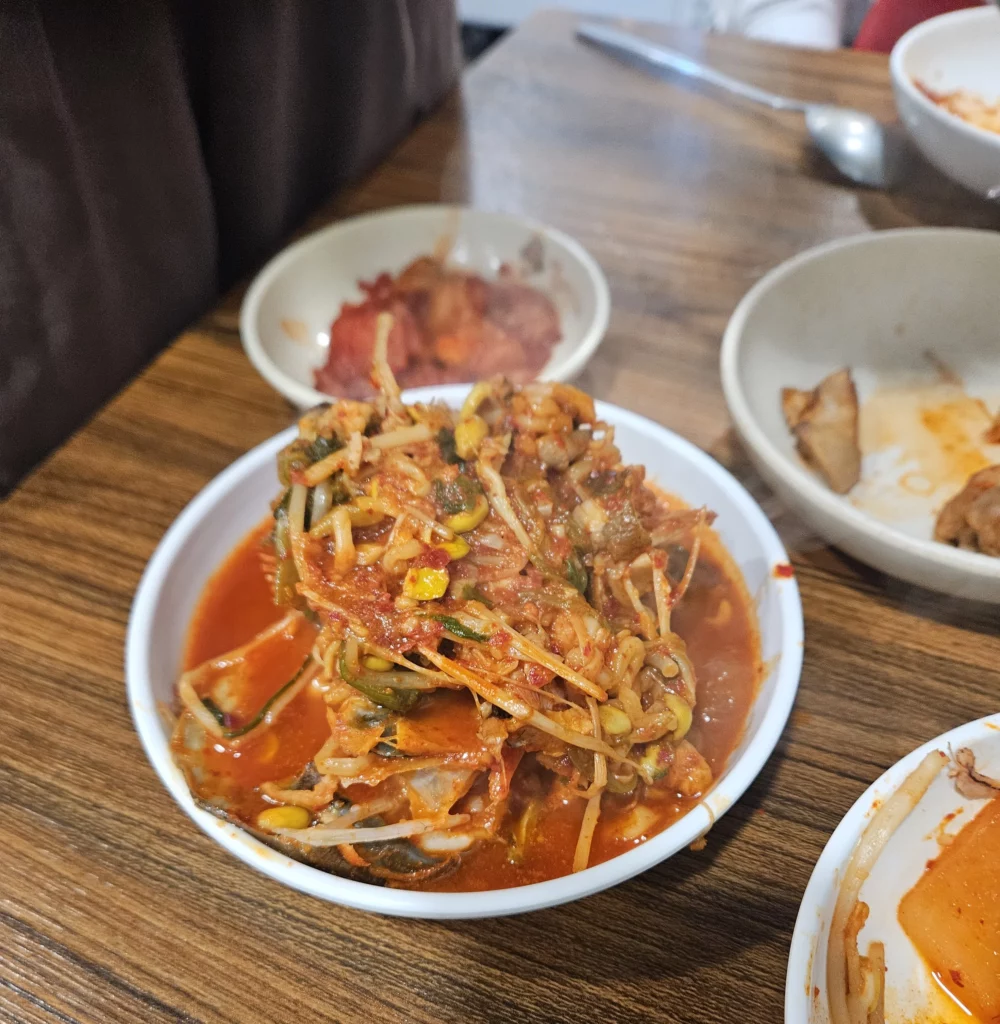
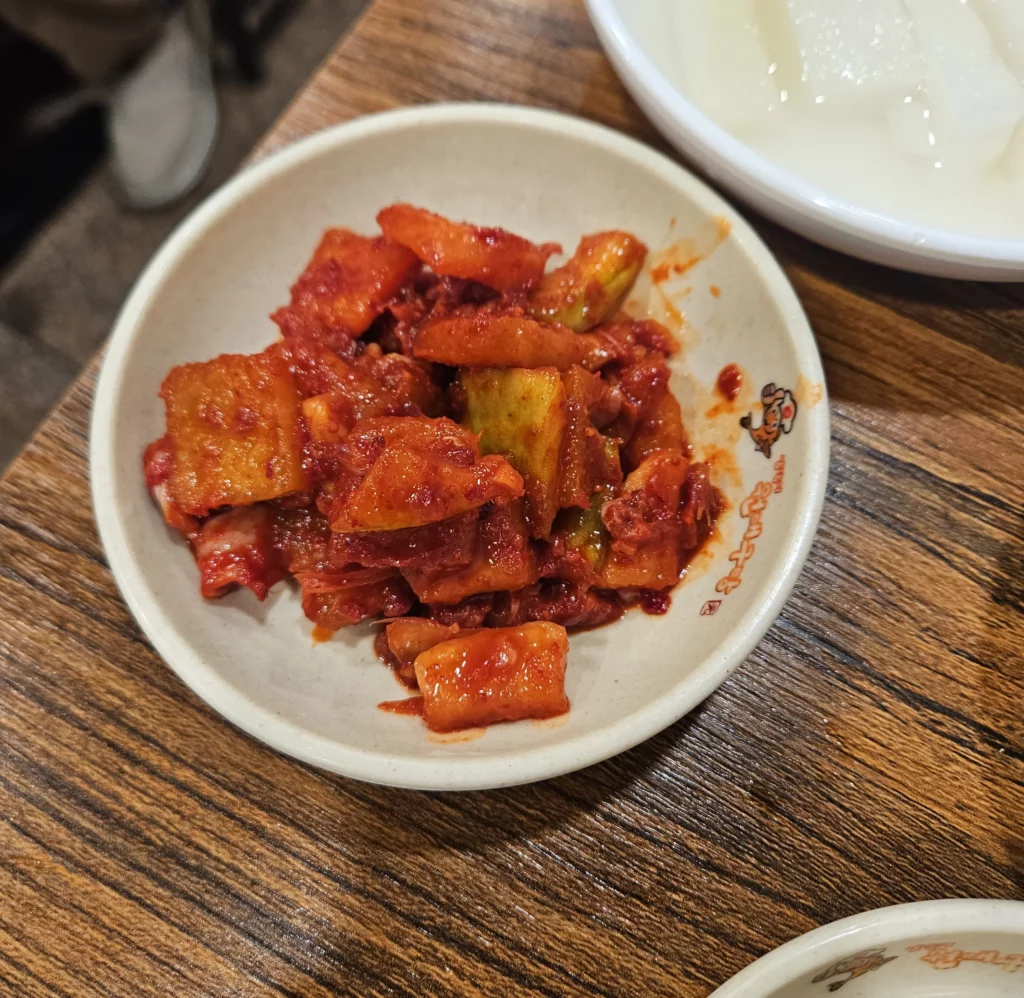
Banchan highlights: Won Daegu-tang’s signature side dish is its agami jeot mukkimchi (아가미 젓 무김치) — radish kimchi made with fermented fish gill jeotgal. It tastes sweet, slightly salty, and deeply savory. While small fish bones occasionally appear in the kimchi, they are soft enough to chew through safely. This unique banchan is impossible to find at other restaurants and contributes to the overall dining experience.
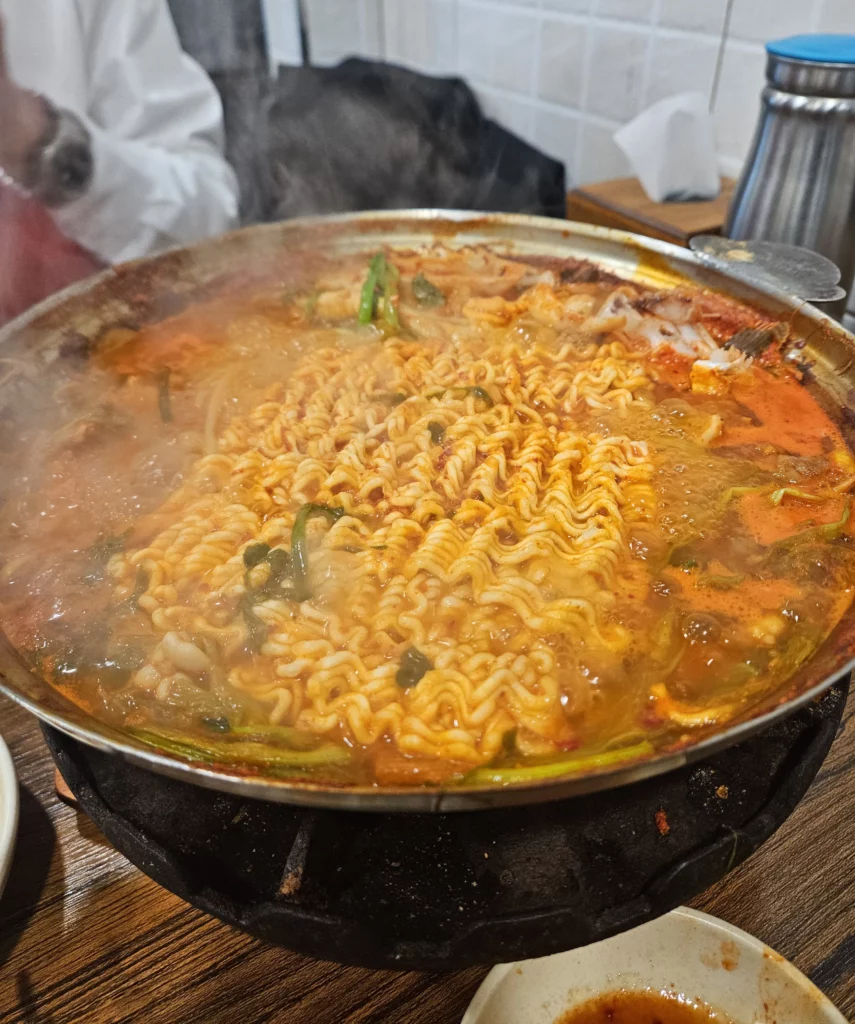
Add-ons: You can enhance your stew with additional innards (₩10,000) or add noodle varieties like ramyeon, sujebi (hand-torn dough), or udon (₩2,000 each). The sujebi is particularly popular for how it absorbs the flavorful broth.
The Secret Finishing Move: Fried Rice in the Broth
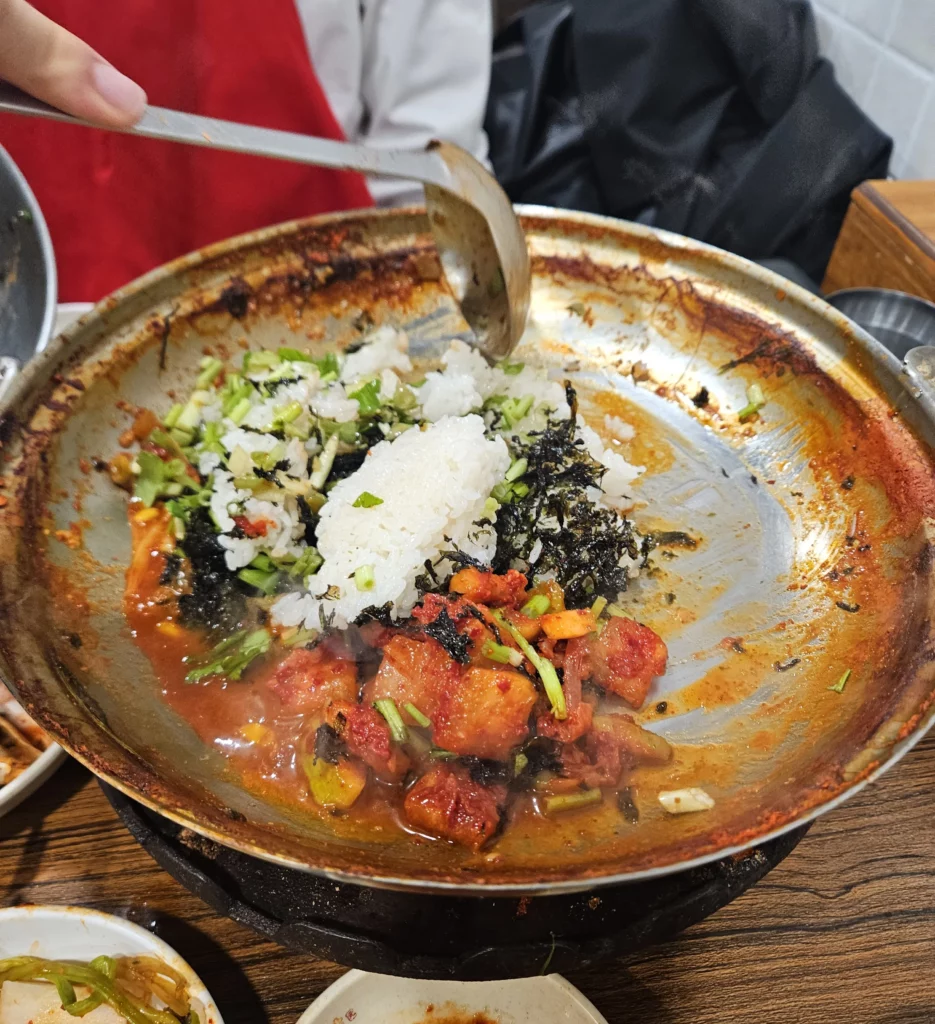
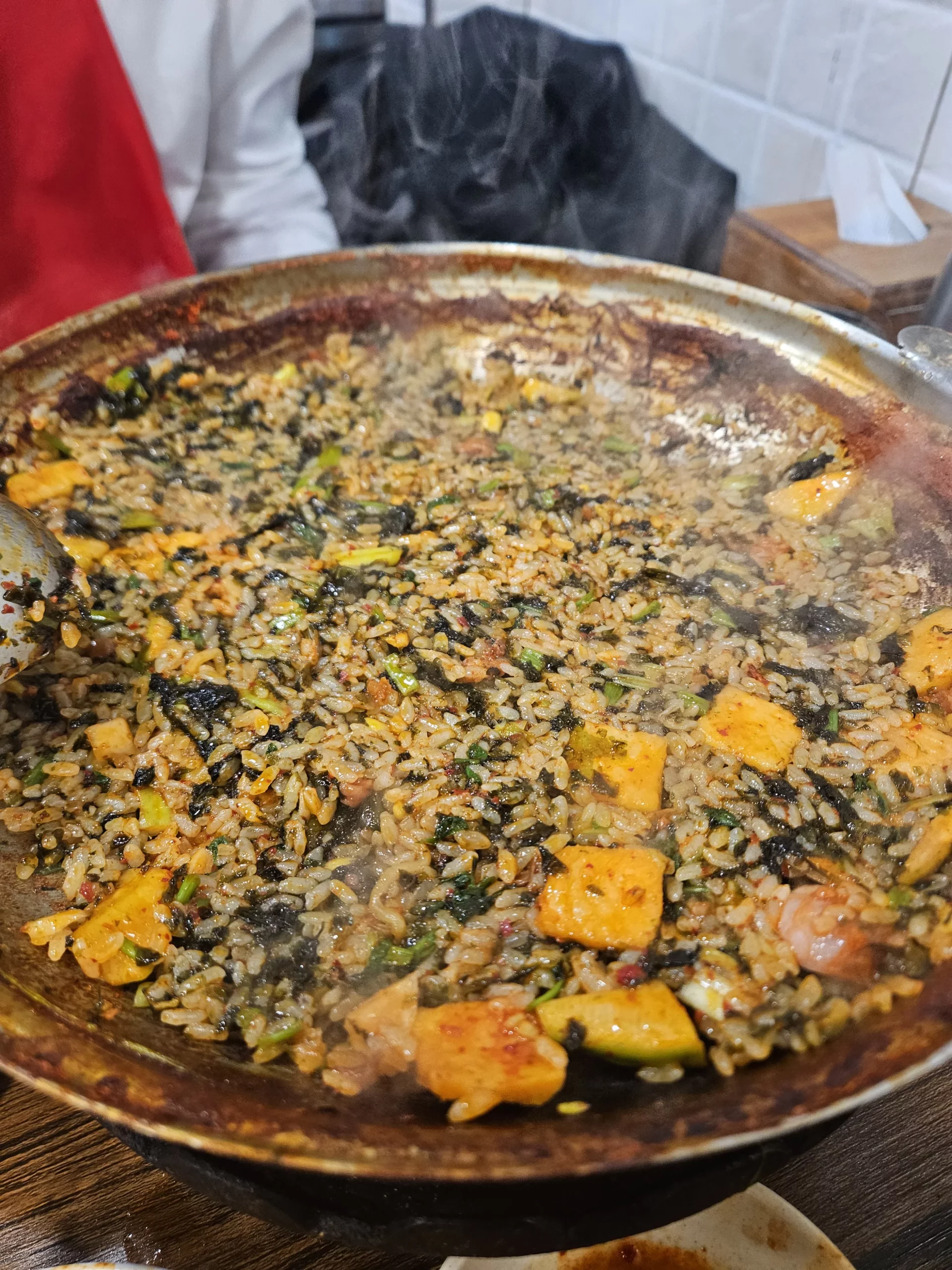
Regulars at Won Daegu-tang know that the meal is not truly complete until you order the bokkeumbap (볶음밥, fried rice) at ₩3,000. After you have eaten most of the cod and vegetables, the kitchen staff take your remaining broth pot and stir-fry rice directly in the concentrated, flavor-packed liquid.
The result is a deeply savory fried rice infused with all the condensed flavors of the stew — fish umami, chili heat, and the residual sweetness of radish. The staff’s skill in spreading and frying the rice evenly using just a ladle is impressive to watch. The restaurant’s own insider tip is to add the agami jeot mukkimchi (gill jeotgal radish kimchi) into the fried rice for an extra layer of salty, fermented richness. This finishing dish alone justifies the visit for many regulars.
Practical Visitor Information
Location and Getting There
Won Daegu-tang is located at 8 Hangang-daero 62ga-gil, Yongsan-gu, Seoul (서울 용산구 한강대로62가길 8). The restaurant sits in a narrow alley just 75 meters from Samgakji Station Exit 1 on Seoul Subway Lines 4 and 6, making it extremely accessible by public transportation.
The Samgakji area also sits near the War Memorial of Korea, one of Seoul’s major landmarks, making it easy to combine a museum visit with lunch at Won Daegu-tang. The Yongsan district is also home to the Presidential Office, which explains the historic presidential visit in 2025.
Hours, Reservations, and Wait Times
DetailInformation
Hours
Daily 10:00 AM – 10:00 PM
Closed
Every Monday
Phone
02-797-4488
Reservations
Not accepted
Parking
Limited; Samgakji Station public shared parking nearby
Expect a wait on weekends. Won Daegu-tang does not take reservations, and the two-story restaurant fills quickly during peak lunch hours (11:30 AM – 1:30 PM) and all day on weekends. Arriving by 11:00 AM on weekdays offers the best chance of avoiding a line.
Full Menu and Prices
Menu ItemPrice
Daegu-tang (Spicy / Clear / Innard) per person
₩14,000 (min. 2 people)
Daegu Twigim (Fried Cod)
₩20,000
Additional Innards
₩10,000
Bokkeumbap (Fried Rice)
₩3,000
Noodle Add-ons (Ramyeon / Sujebi / Udon)
₩2,000
Takeout (Uncooked, min. 2 servings)
₩13,000 per serving
Atmosphere and What to Expect
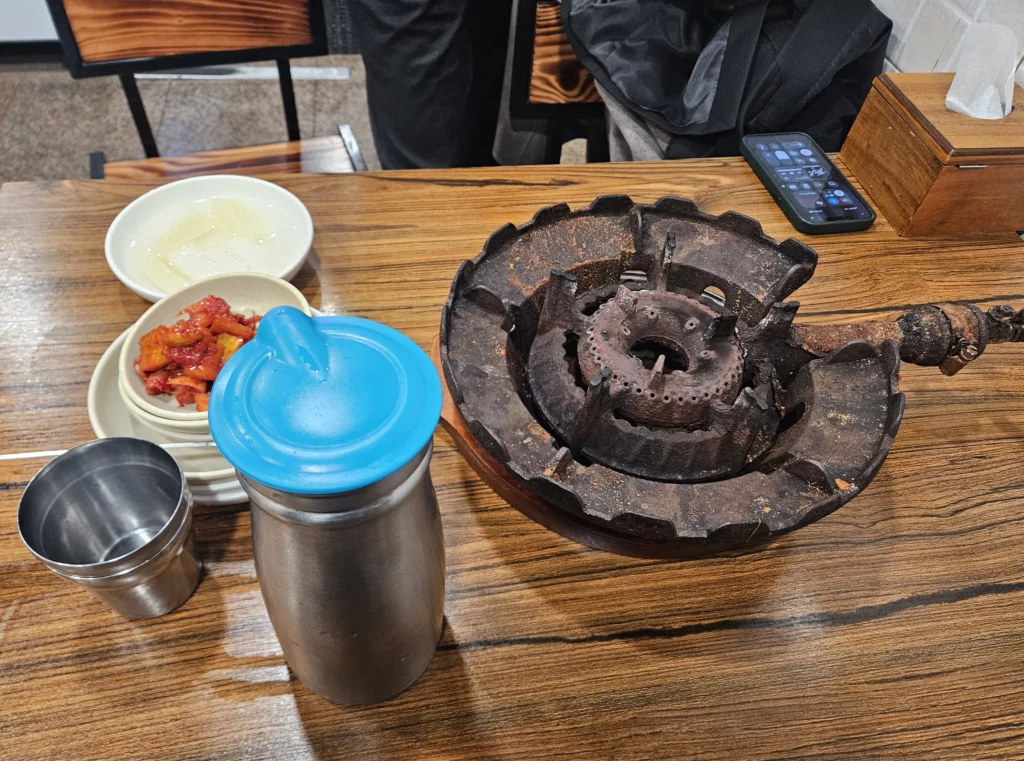
Won Daegu-tang is a classic nopo (노포) — a Korean term for beloved old-school restaurants with decades of history, no-frills décor, and food that speaks entirely for itself. The interior is functional rather than stylish: tiled floors, basic tables, fluorescent lighting, and walls covered in celebrity signatures and TV appearance photos. The atmosphere is lively and bustling, with the constant clatter of spoons against stone pots and animated conversation filling the two-story space.
This is not a quiet, contemplative dining experience. It is loud, crowded, and wonderful — exactly the kind of place where Seoul’s food culture thrives at its most authentic. The staff are efficient rather than ceremonial, moving with the practiced speed of people who serve hundreds of customers daily.
Frequently Asked Questions
Is daegu-tang good for someone who doesn’t like spicy food?
Absolutely. Won Daegu-tang’s malgeun-tang (clear version) contains no chili at all and tastes clean, mild, and gently savory. It is one of the most approachable Korean stews for visitors who prefer milder flavors, similar in gentleness to samgyetang (Korean ginseng chicken soup). Even the spicy version is moderate by Korean standards and considerably less intense than stews built on gochujang fermented chili paste.
Can I visit Won Daegu-tang as a solo diner?
The stew requires a minimum order of two servings, which is standard at most Korean stew and hot pot restaurants. Solo diners can still visit and order two servings — the generous portion is enough for a very hearty solo meal with leftovers for fried rice. Alternatively, the restaurant offers uncooked takeout portions at ₩13,000 per serving (minimum two) for those who want to prepare it at home.
What nearby restaurants or attractions pair well with a visit?
Samgakji is part of Seoul’s Yongsan district, which offers excellent options before or after your meal. The War Memorial of Korea is within walking distance and is one of the city’s most impressive museums. For those exploring Seoul’s food scene further, the nearby Itaewon and Hannam-dong neighborhoods offer diverse dining. If you are specifically interested in Korean food alleys and heritage restaurants, consider exploring Seoul’s Gwangjang Market food stalls for another authentic culinary experience.
Share this guide with anyone planning a trip to Seoul’s food scene — and leave a comment below if you have visited Won Daegu-tang yourself. Planning to try Korean cod fish stew for the first time? This is the place to start.
Published: February 28, 2026 | Last Updated: February 28, 2026